How often do I ever meet any ambassador from any country? Well, until a few weeks ago it was never. A few days into our trip we all went over to the new U.S. embassy in Yangon and met with Mr. Larry Dinger, who is the U.S. Chargé d’Affaires for Myanmar. Because of various policy disagreements the U.S. government has with Myanmar they don’t want to say they have an ambassador in Myanmar. The post is not vacant, however. While I suppose he would not officially say this, Mr. Dinger is the U.S. ambassador in all ways except the name.
We discussed our book donations to Myanmar and its importance in helping the country to move into the modern, largely English speaking, international community better. While the U.S. does maintain trade sanctions against Myanmar, they have granted our organization an exception, and at various levels, including Mr. Dinger’s, have been most willing to do what they can to help us bring in our books.
The new embassy was certainly impressive, although I have to admit it is the first embassy of any country that I have been in. I wish I could have taken some pictures but that is not permitted at all. I looked on the internet and could not find any there either. If Mr. Dinger reads this maybe he’ll send me some that I can use here.
We met several other people there and all were most helpful.
Near the end of our visit we discovered that many children’s books that Hector had donated to the Asia foundation had in fact found their way to the Embassy library where we found them sitting in boxes on the floor waiting to be unpacked. From there they will be distributed to other parts of Myanmar with some going to the American Center library in Yangon. I would have taken a picture to show you but…
That evening we met Mr. Dinger along with several other ambassadors and some heads of large corporations still operating in Myanmar at a dinner. This was at an impressive restaurant at a very nice hotel. I sat next to the ambassador of another country, with yet another ambassador next to her. Sue sat next to Mr. Dinger on down the table. I will release one detail about Mr. Dinger. If you ever have him over for dinner serve sushi and you will have one happy camper.
Each of the Nargis Library board members spoke briefly to explain their connection to our organization and why we think it is so important. John talked about overall strategy and how our books and more education will impact Myanmar for the better. Hector spoke about book supplies and what books we can bring to Myanmar. I talked about the tremendous opportunity I have found in our organization in that a very small amount of money can make a tremendous difference for an entire country. This is because we 1). have a free supply of very good quality books from Thrift Books and 2) American President shipping lines is transporting our large containers of books to Myanmar at zero cost. We are bringing high quality books into Myanmar for about four or five cents apiece. Finally 3) we have many people not the least of whom are the Bhuddhist monks of Myanmar who are willing to help us distribute and house books at little or no cost to us.
I won’t say it was a gala event because none of us wore a suit or a tie and the ladies, while dressed quite nicely, were not in any kind of formal attire. Still, it was a most interesting evening.
What we do with many of the books we bring in is give them to the Buddhist monks. I’m not sure whether we make any merit in the Buddhist sense, but many temples in Myanmar have libraries that house our books and are used by their communities. The monks also distribute the books to these at little or no cost to us. They run a number of schools that can use our books as well.
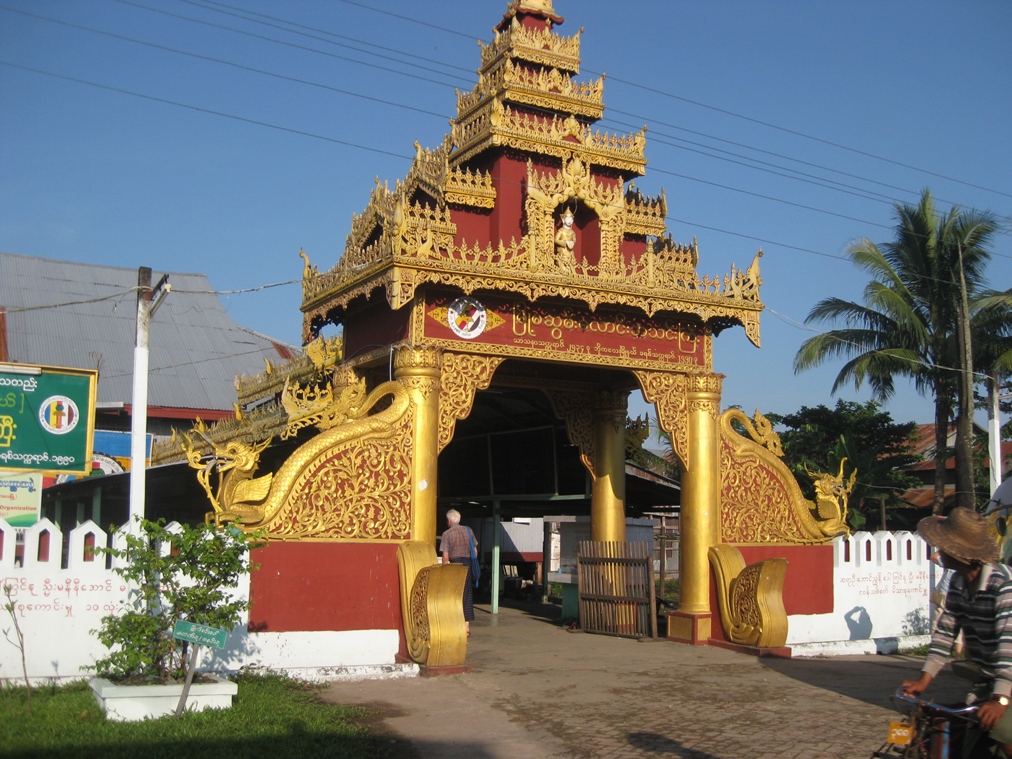
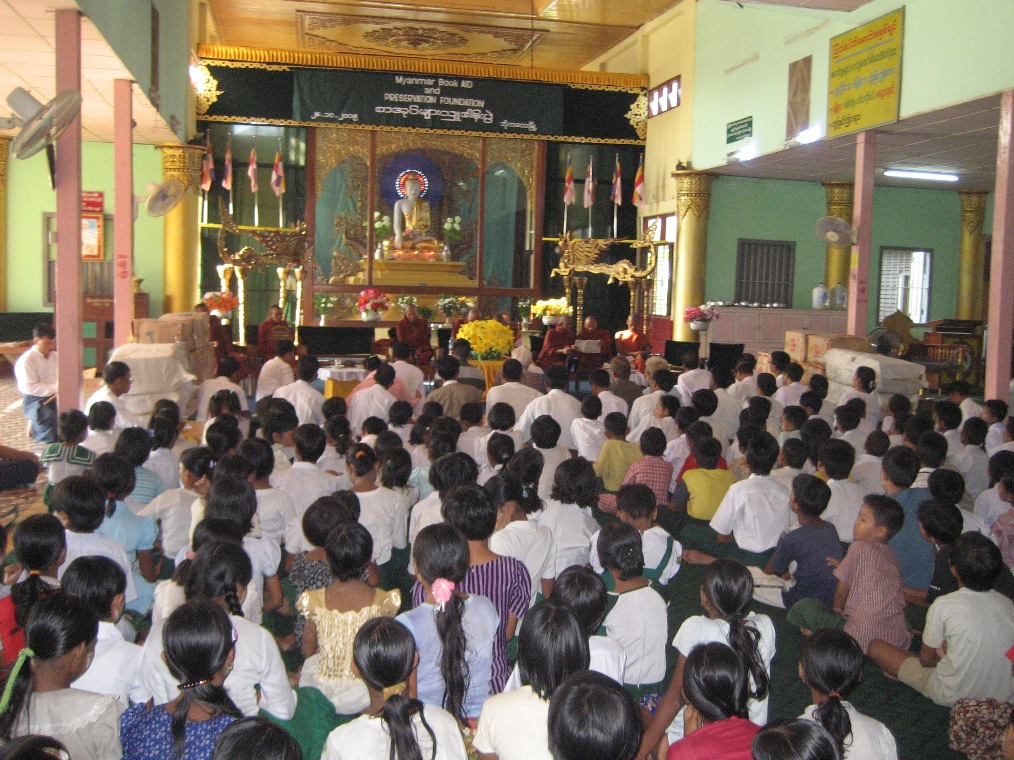
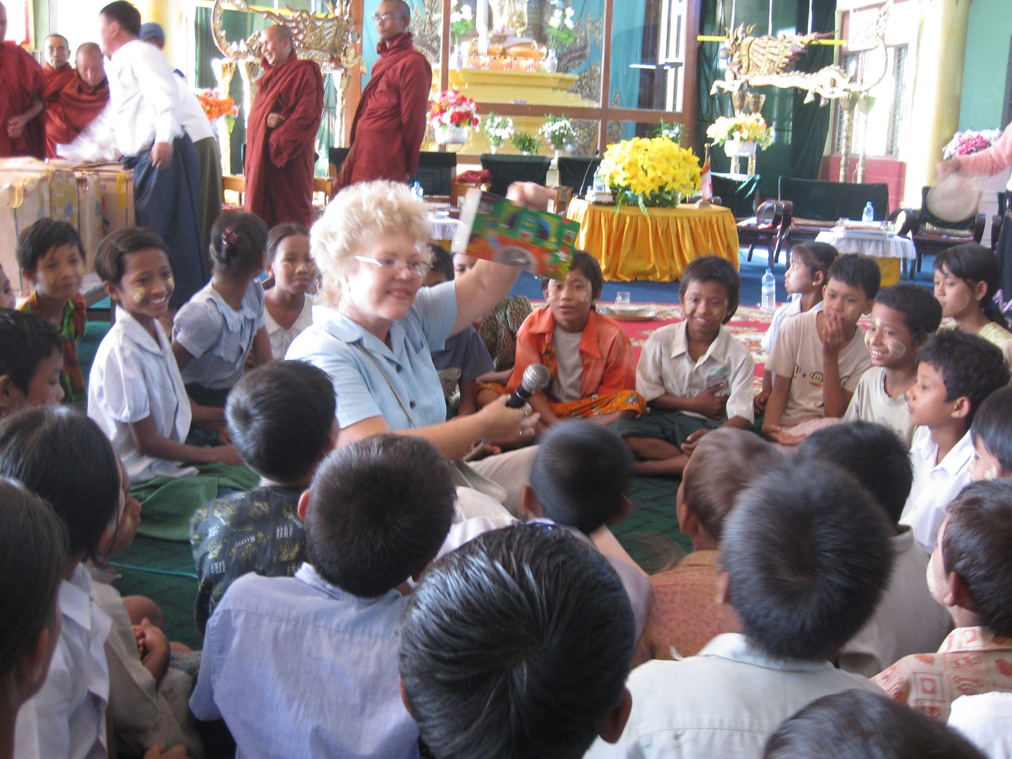
Things are done in the Buddhist way, with appropriate ceremony. Several of these presentations have occurred in the past in various parts of Myanmar but this is the first that I have attended. The monks are in front, the adults facing them in the audience, and the children from the temple school are behind. The banner of Myanmar Book Aid and Preservation Foundation, our counterpart organization in Myanmar, is over the front area. The boxes on either side between the monks and the audience hold our books. The brown boxes are primarily English language children’s books while the white boxes are Burmese language books purchased from the proceeds of selling some of the popular fiction and non fiction books we bring over at book fairs in Yangon.
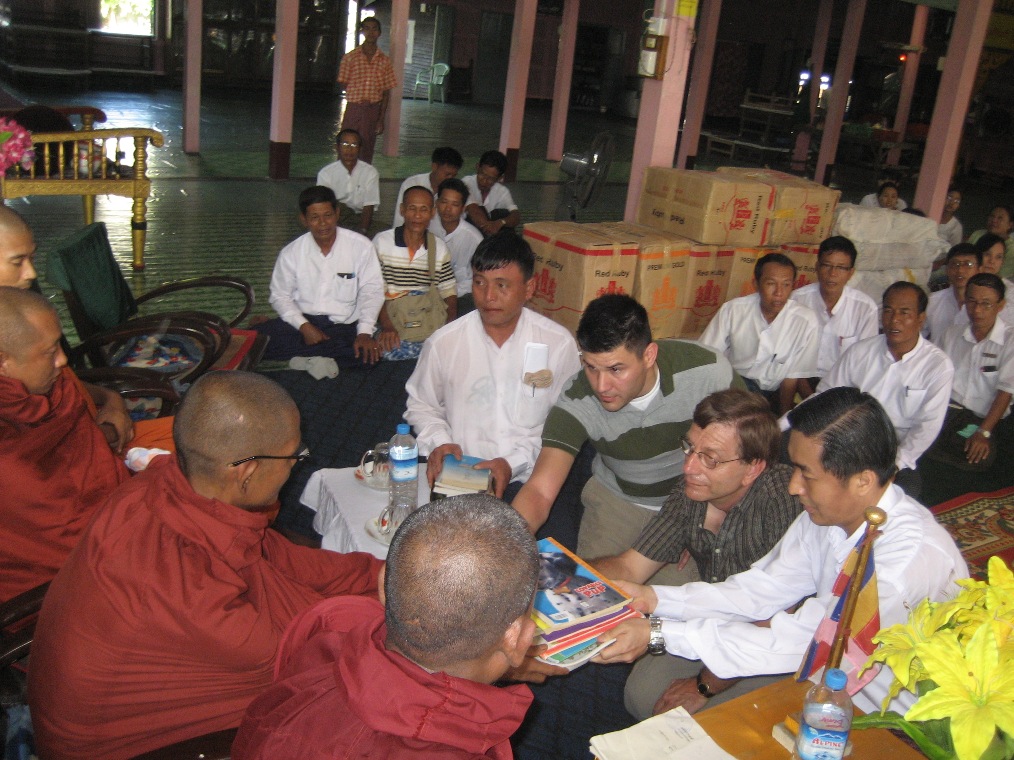
The actual presentation occurred when Hector, Thant and I handed a small stack of books to a monk. We did this several times to about four of the monks.
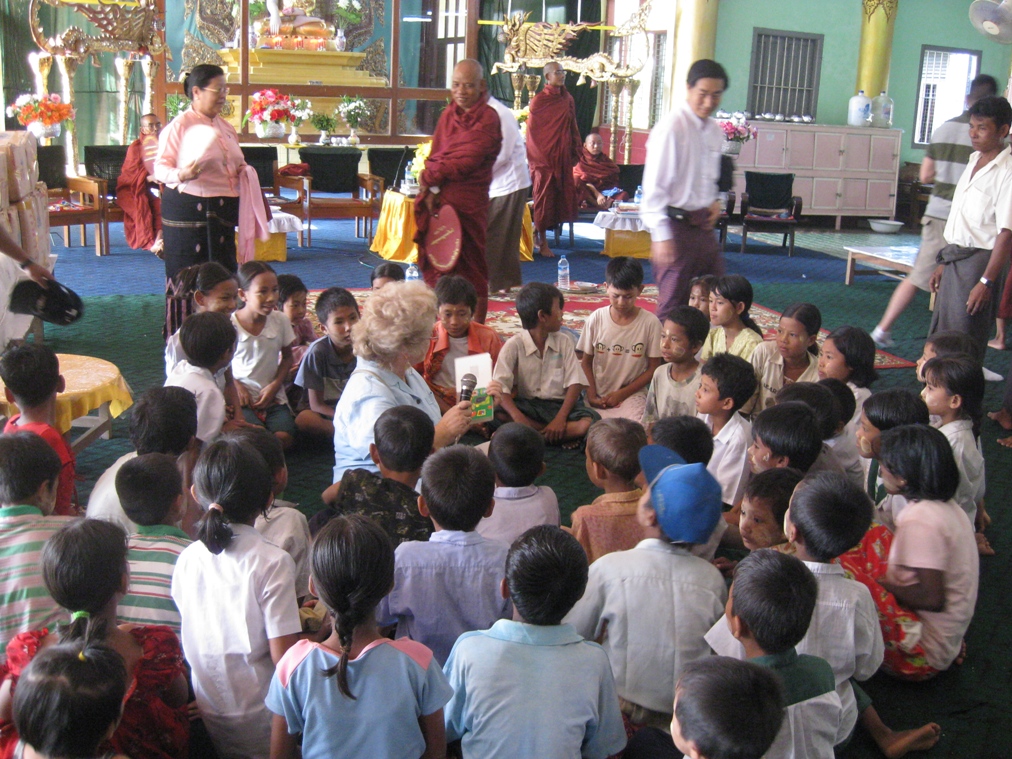
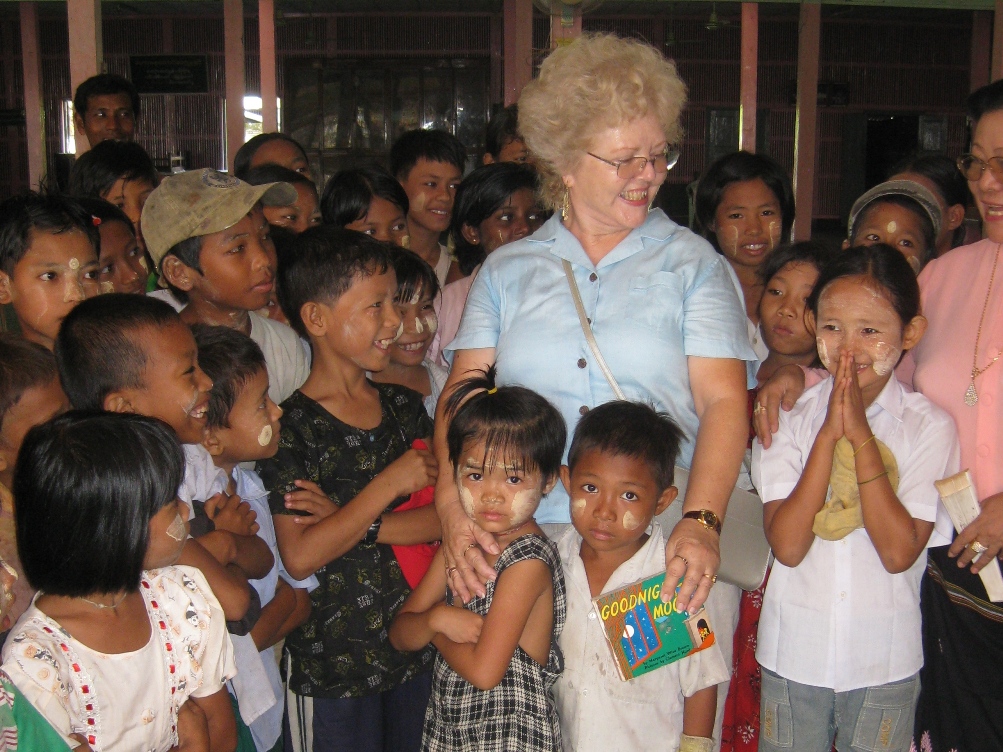
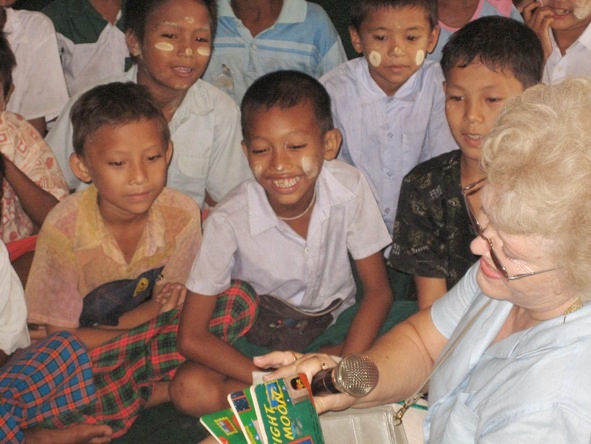
After we had presented the books to the monks and the ceremony was over Sue presented a book to to the children. The way they quickly got into position around her on the floor indicated they sit with a teacher this way often. It worked better than I would have thought. I suppose her experience teaching kids in the Indian slums English in part by reading to them helped. Also the book “Goodnight Moon”, like most of our children’s books, has many pictures and few words. I think this helped, and hope it will help the children to learn English as they use these books in their schools and libraries.
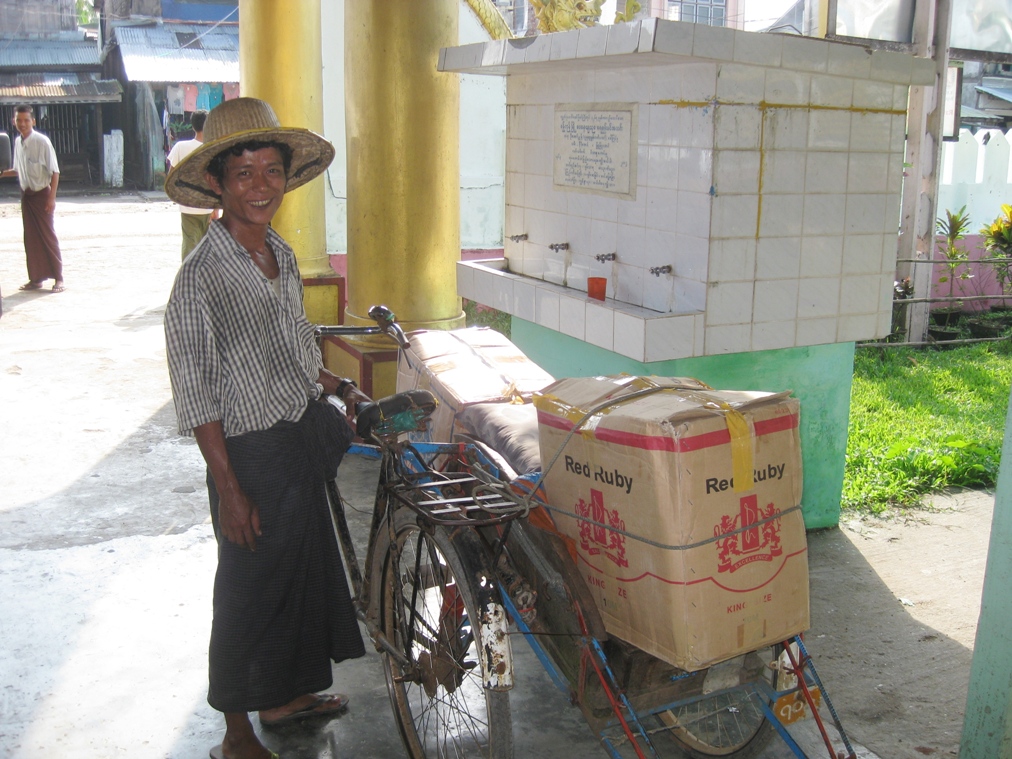
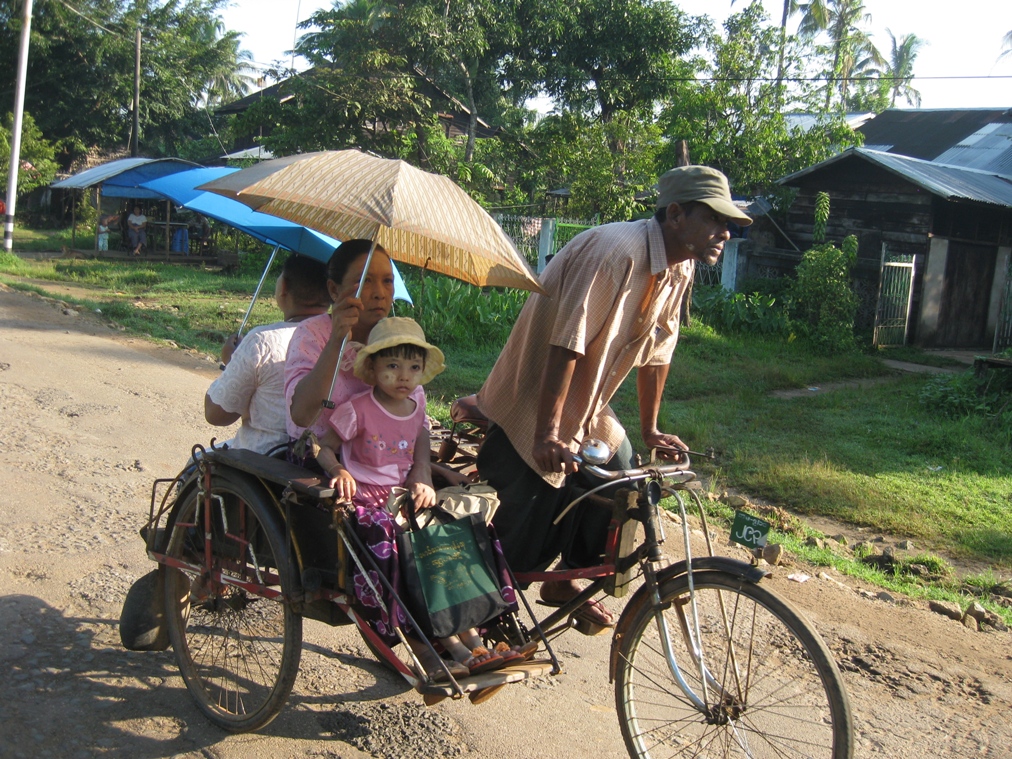
I got distracted by Sue reading to the kids but still managed to catch part of the distribution network before he got away on his bicycle taxi.
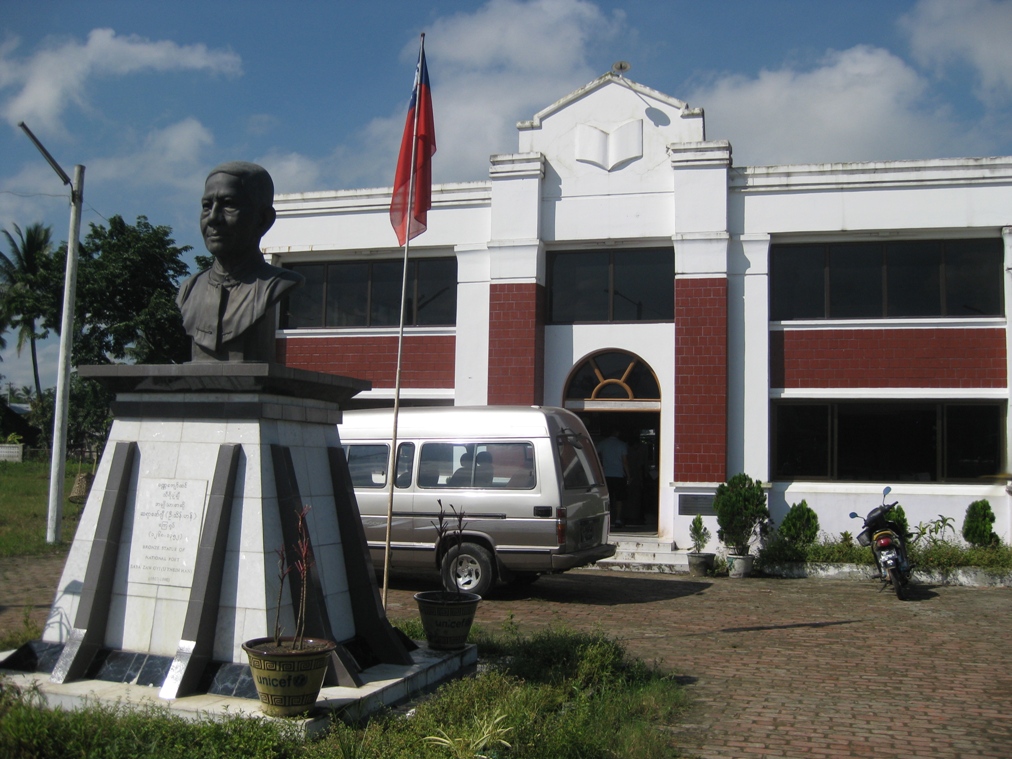
We stopped at several libraries on this trip. The Saya Zawgyi Centinary Library in Pyarpon on the way back stood out. We met with the library board. These men represent the “grass roots” people that we deal with. They are essential to our success and their country’s education. We went over records, check out proceedure, etc. and saw that circulation was substantial for a library of that size. Many of our books were already in this library, with more to come.
I don’t go to the library much. I buy books I read from a bookstore or online. It was an eye opener for me to realize how important libraries are in Myanmar. They don’t have the money to buy a book, and if they did, where will they get English language books, even in Yangon? Even if they could get online Amazon does not deliver in Myanmar. Fortunately for us, with the help of American President shipping lines, Thriftbooks does.
(Usually all the pictures here are mine, but videos and a few pictures taken by board member Hector Rivas were too good to leave out in this and a few following posts. Click on active words in the text to view the videos.)
We took a two day trip in a van to the city of Bogalay which is in the north east part of the southern delta area. We visited libraries and some monastery schools there and in the surrounding area. The highlight of this trip was traveling by a small boat which just held our group to riverside villages in the area. There we again learned about education and libraries in the more outlying areas.
If you’re looking for Bogalay you might try spelling it “Bogale” also. Some spell checkers, and Google maps spells it that way.
The delta area of Myanmar was devastated by cyclone Nargis over a year and a half ago. Most buildings in this area at least lost their roofs if they were not entirely flattened. A lot of rebuilding has occurred in the last year and a half. In some ways it is easier here than other more developed parts of the world since there is less complexity to be rebuilt. Still, we heard stories of how hard it was for children to come back to school and study after they had lost most of their families, their homes, or whatever else a child might have to lose.
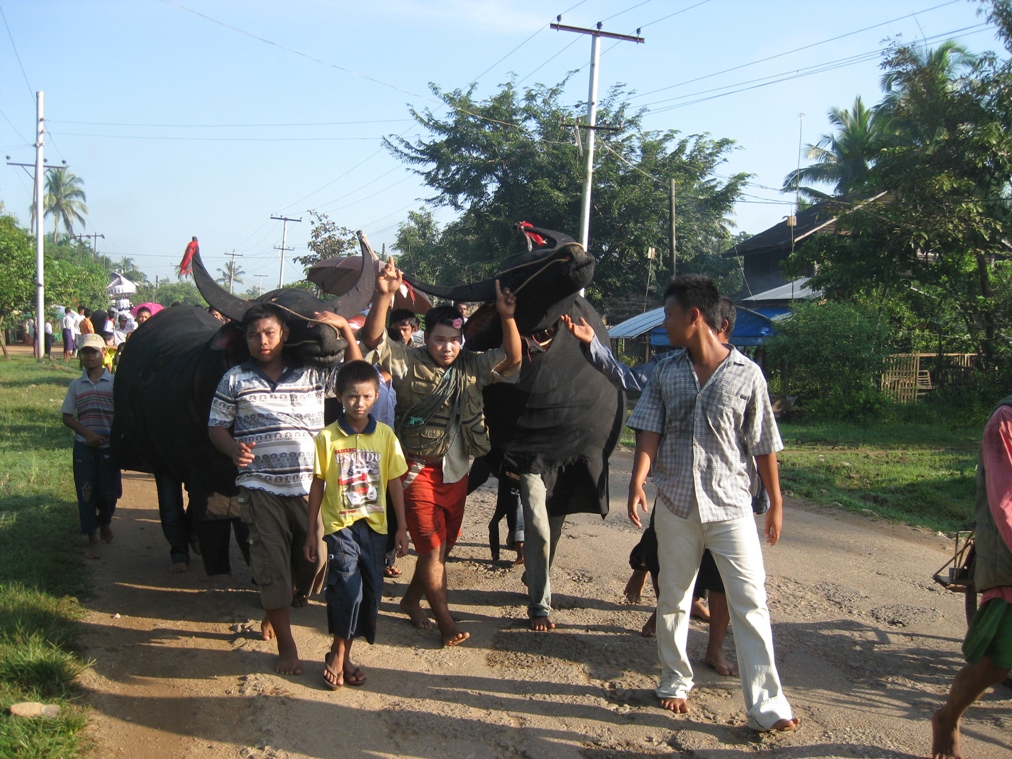
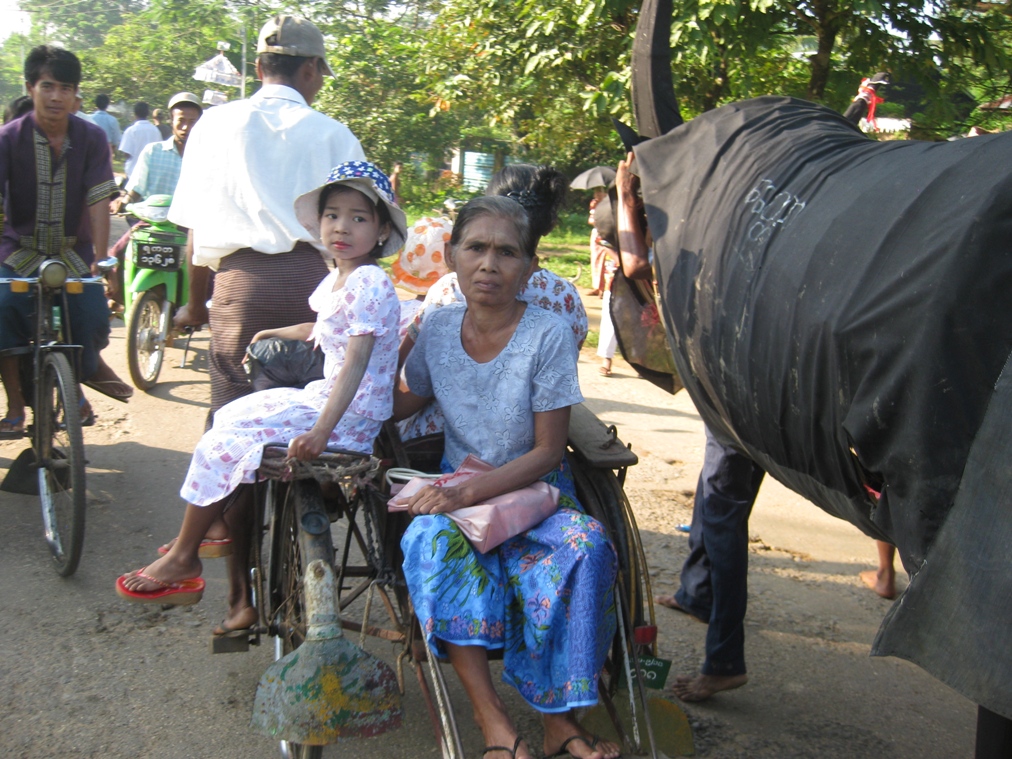
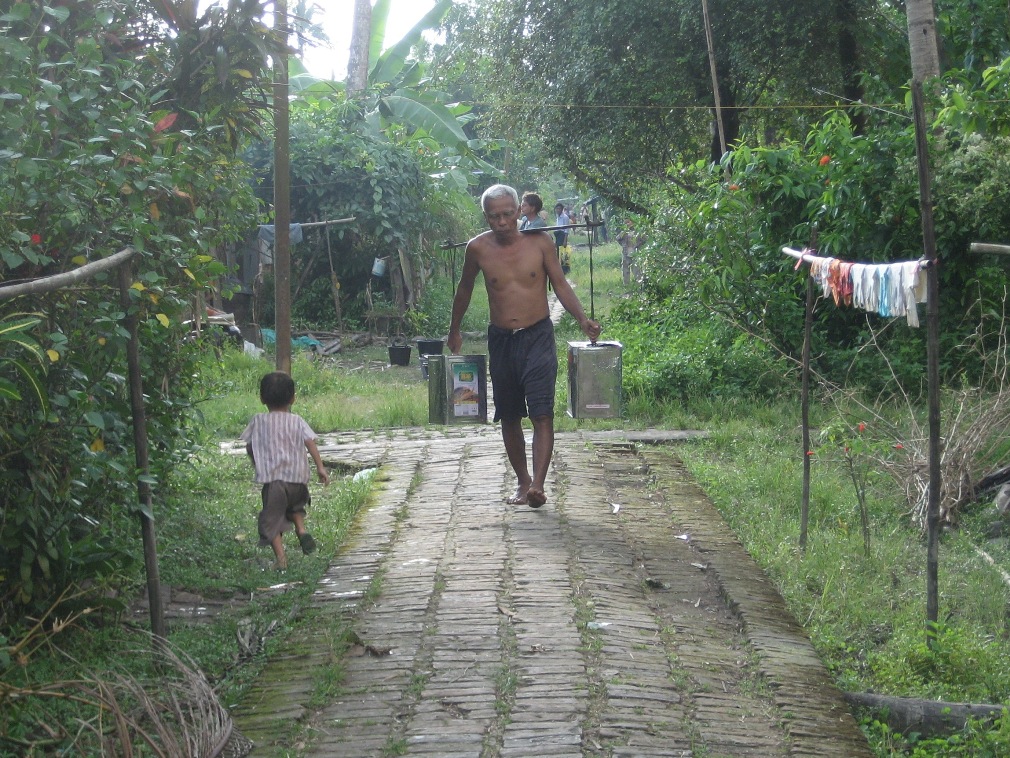
The trip down was made by van on the handmade roads of Myanmar. These are made from one to three inch rock placed by hand and then rolled. Because of the rocks they are bumpy in a way that makes a lot of noise and must be wearing on the car, but does not shake the passengers. Potholes do not seem to develop in these type roads. I think if they can put good layer of asphalt over such a base they’ll have some long lasting roads. We saw very few cars, buses and motorbikes but a lot of bicycles and bicycle taxis. At one point we ran head on into a Buddhist Ka-htain donation celebration on the road and had to stop. Men were in buffalo costumes (see video) and other men “fought” them. Ka-htain marks the end of 3 months of Waso (Buddhist Lent) in which monks are not allowed to travel. The monks are now back out and receiving offerings.
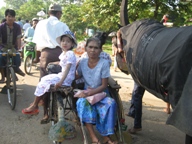
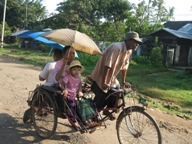
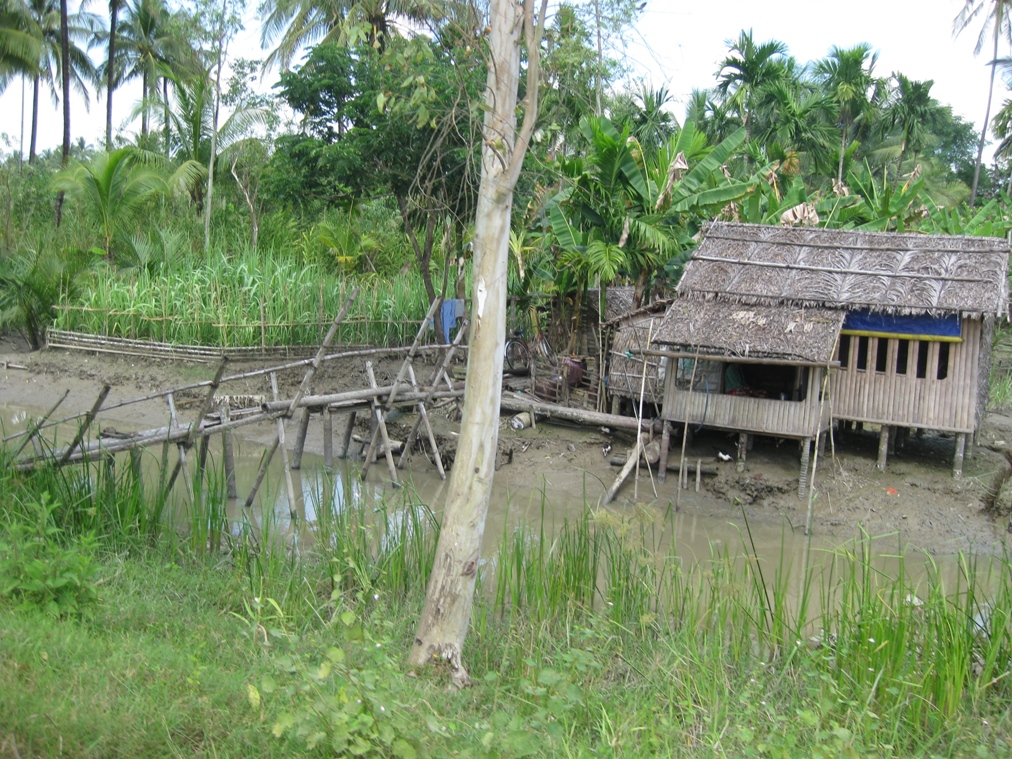
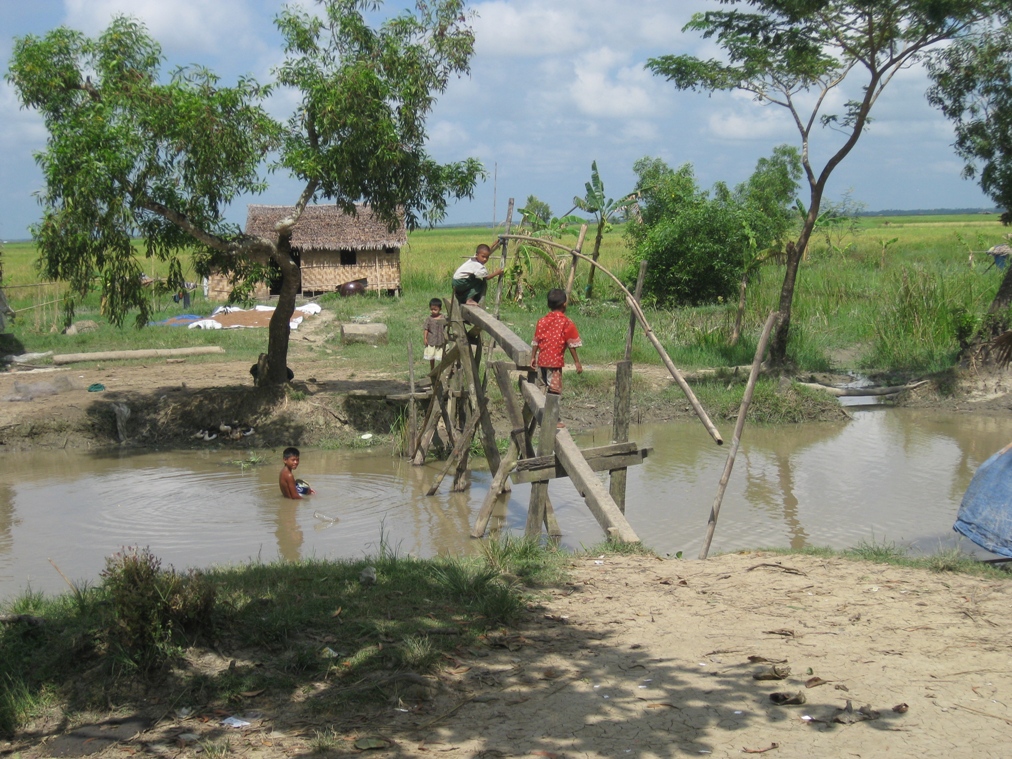
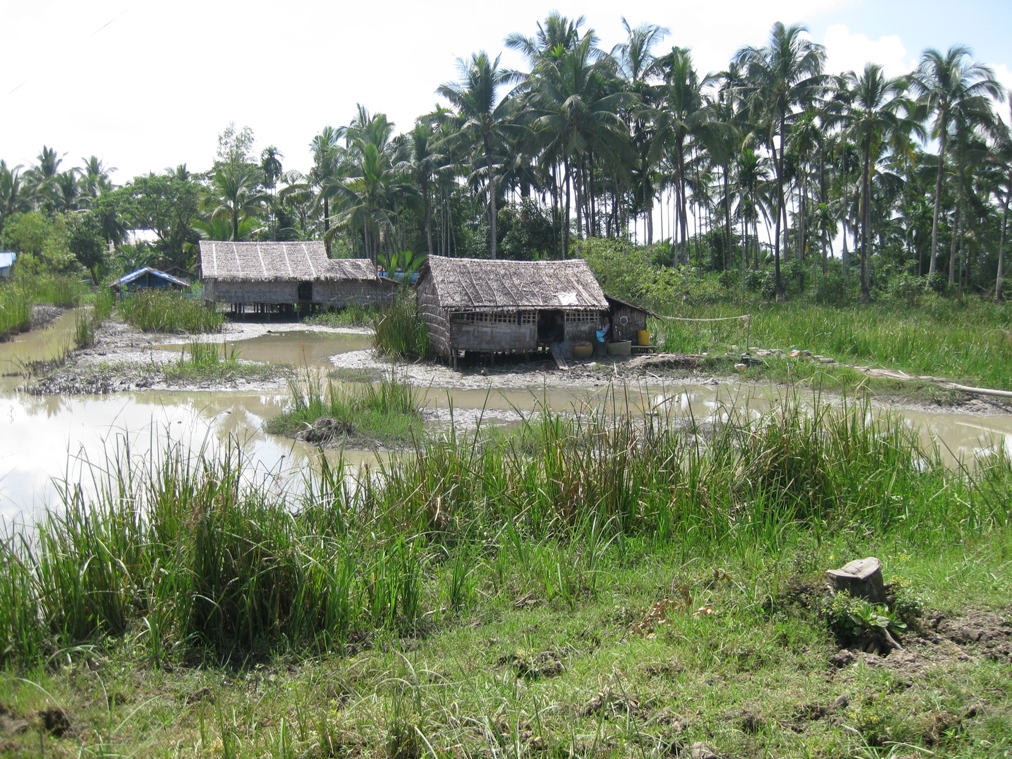
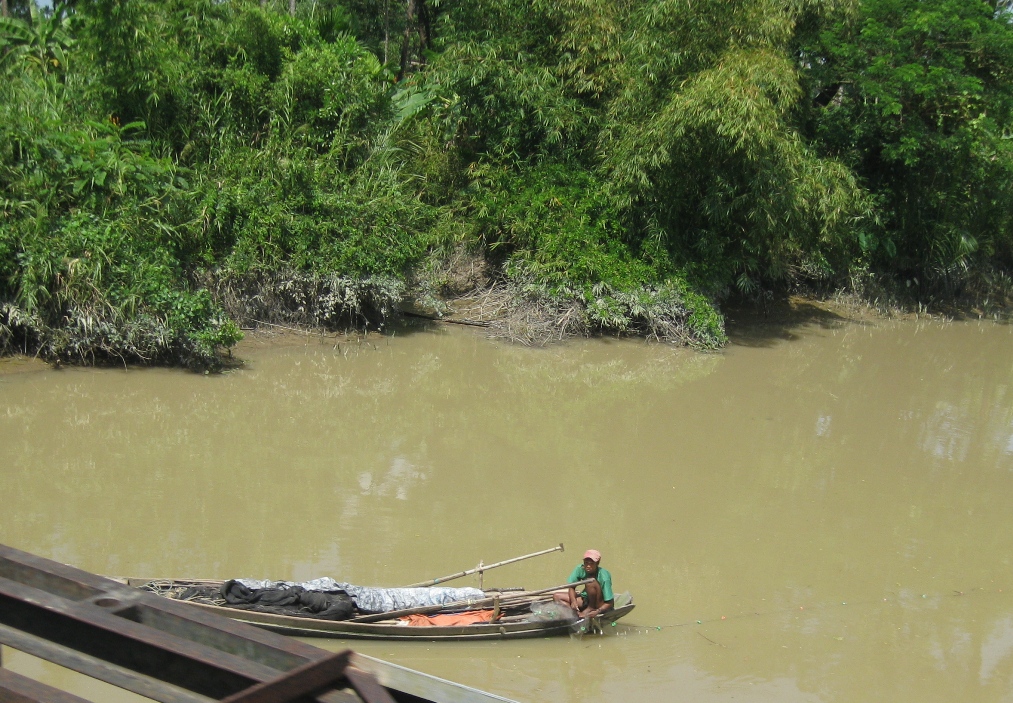
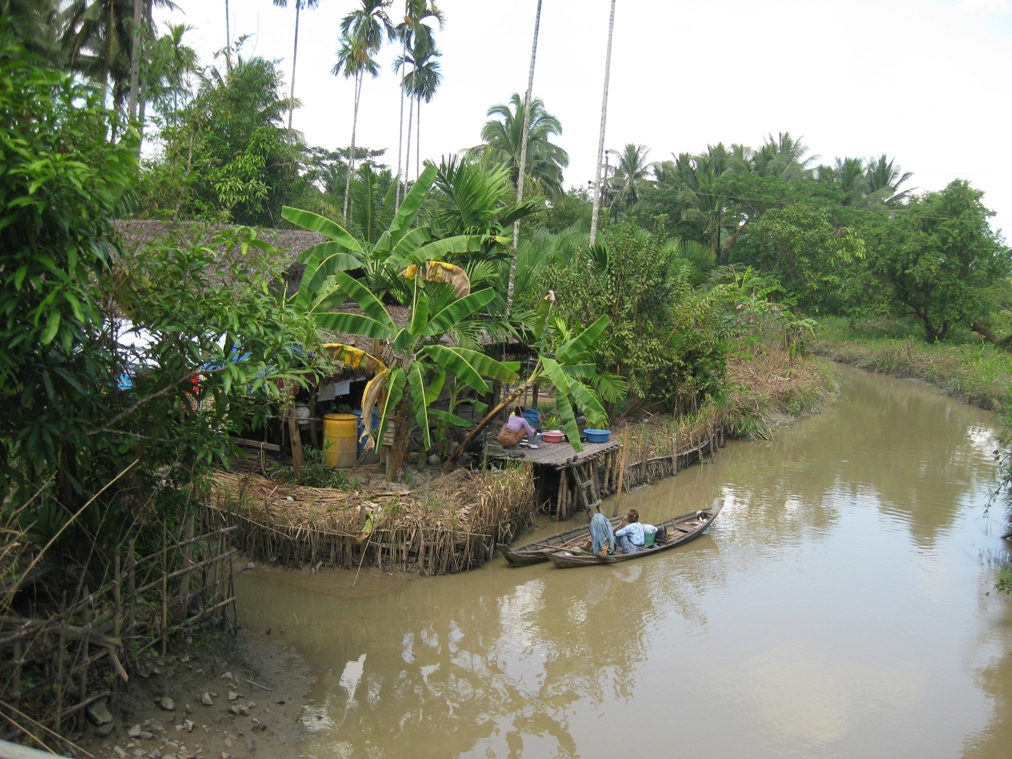
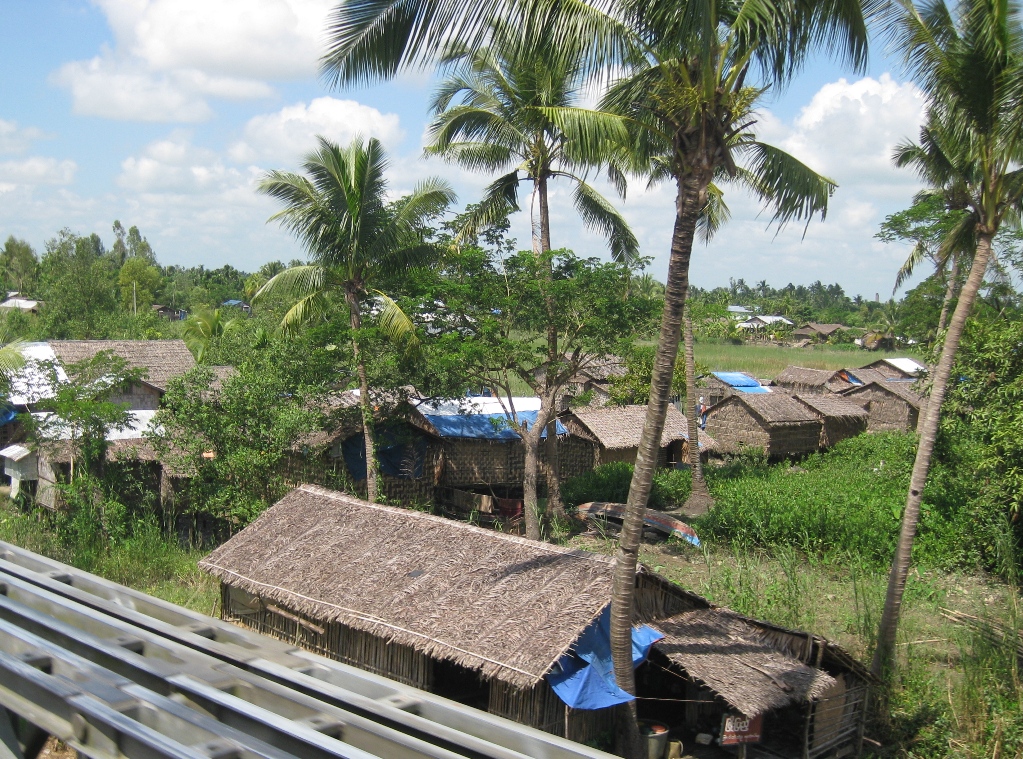
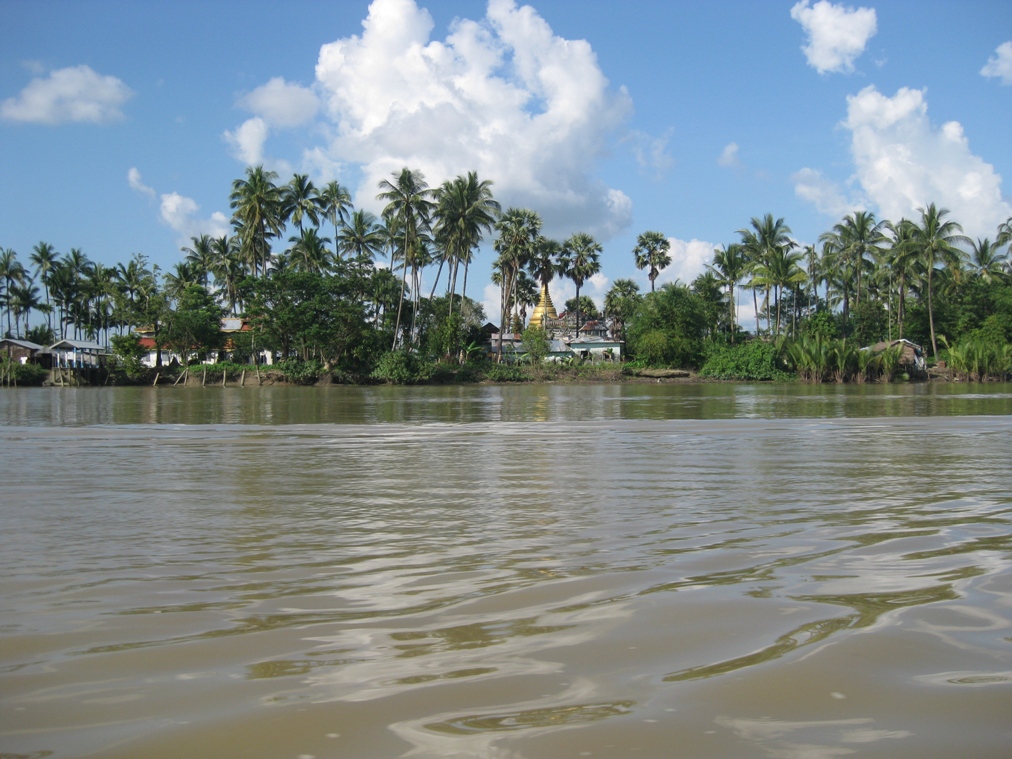
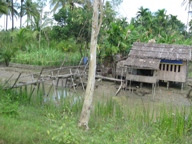
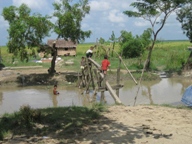
The view was countryside most of the time. Many of the photos here were “drive by” from a moving car, so please forgive the tilt and maybe lack of clarity. Often there would be a canal near the road so that access to homes was via a log bridge. This is the delta area, so we went over a number of small and some large bridges. I tried to get these water areas as we passed.
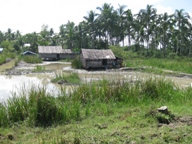
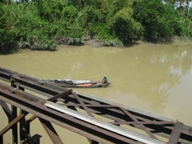
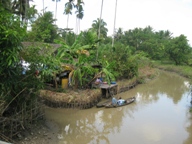
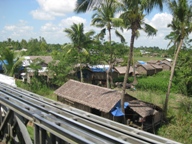
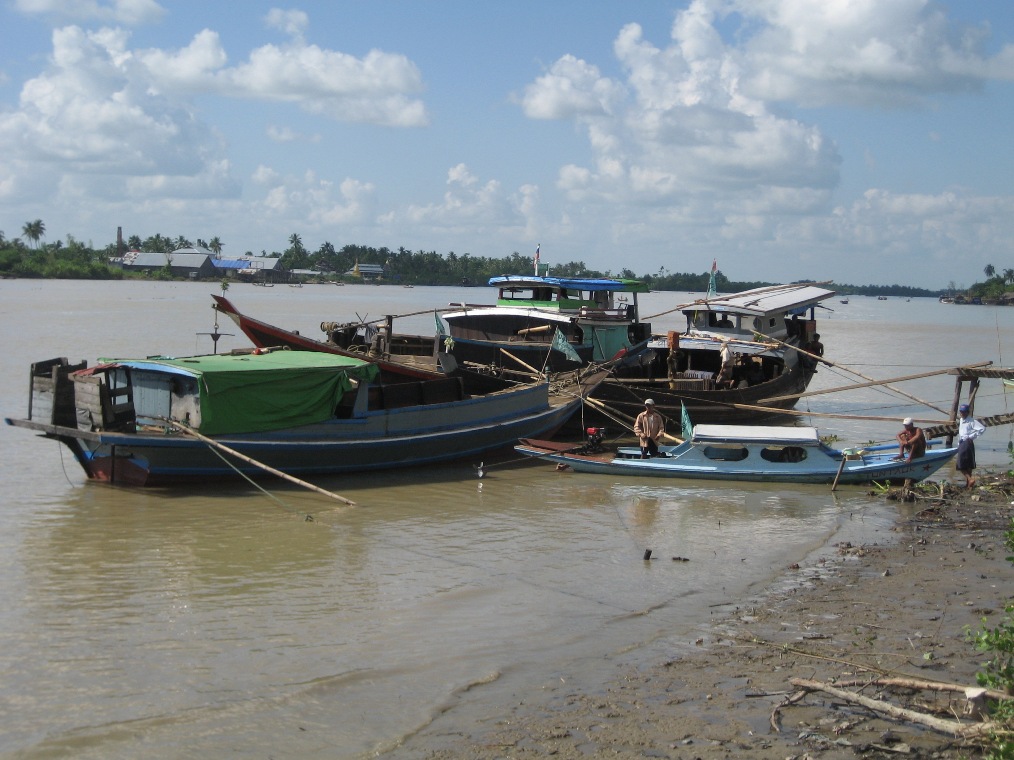
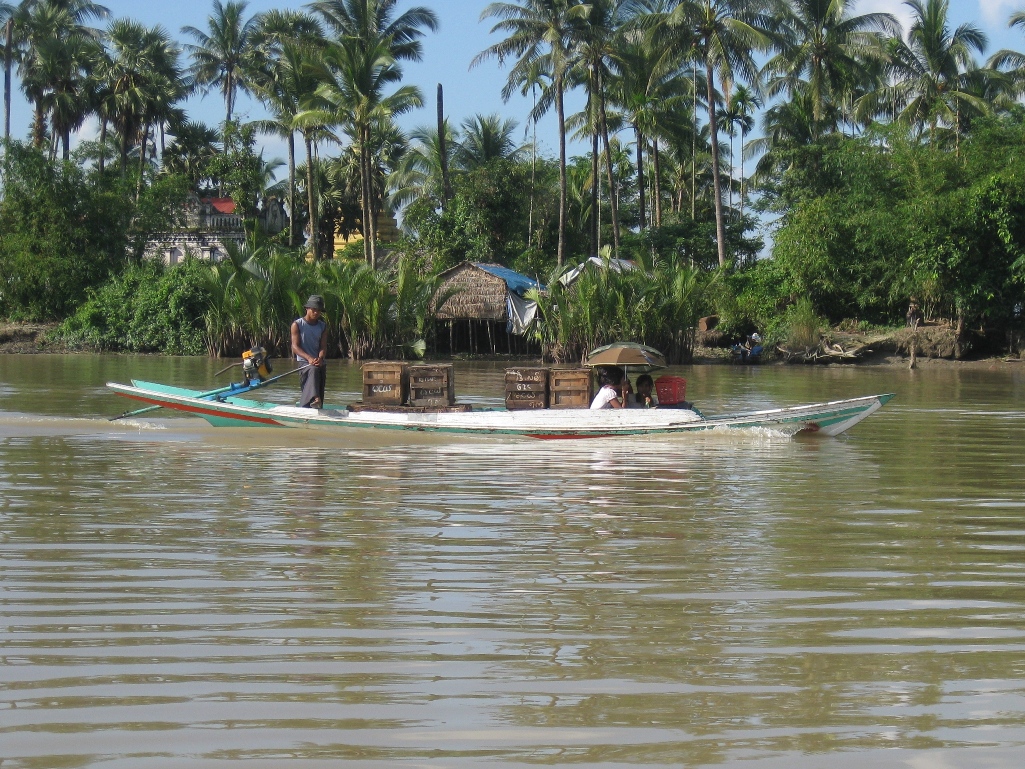
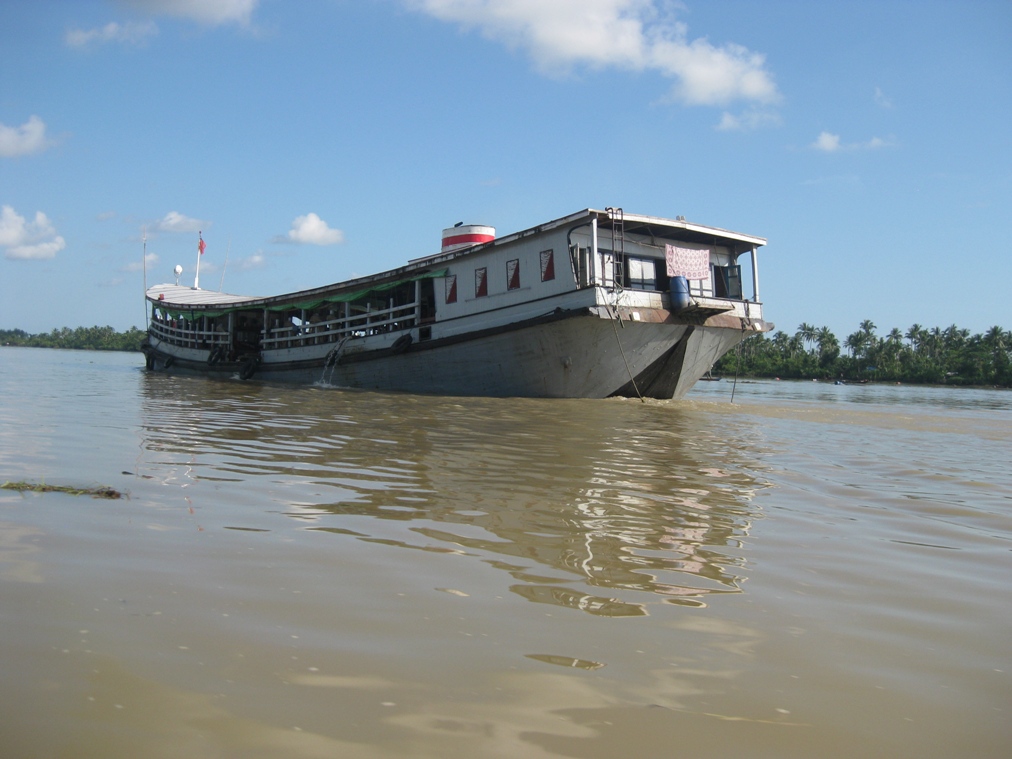
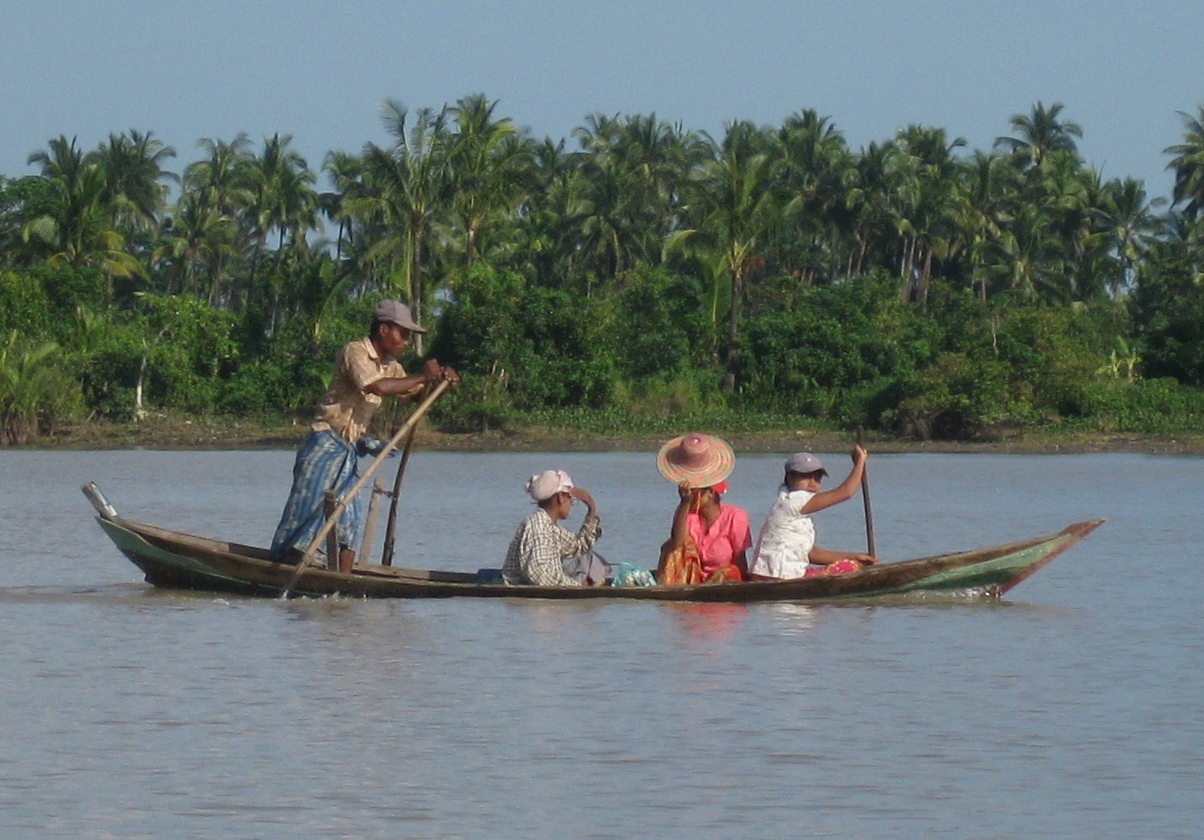
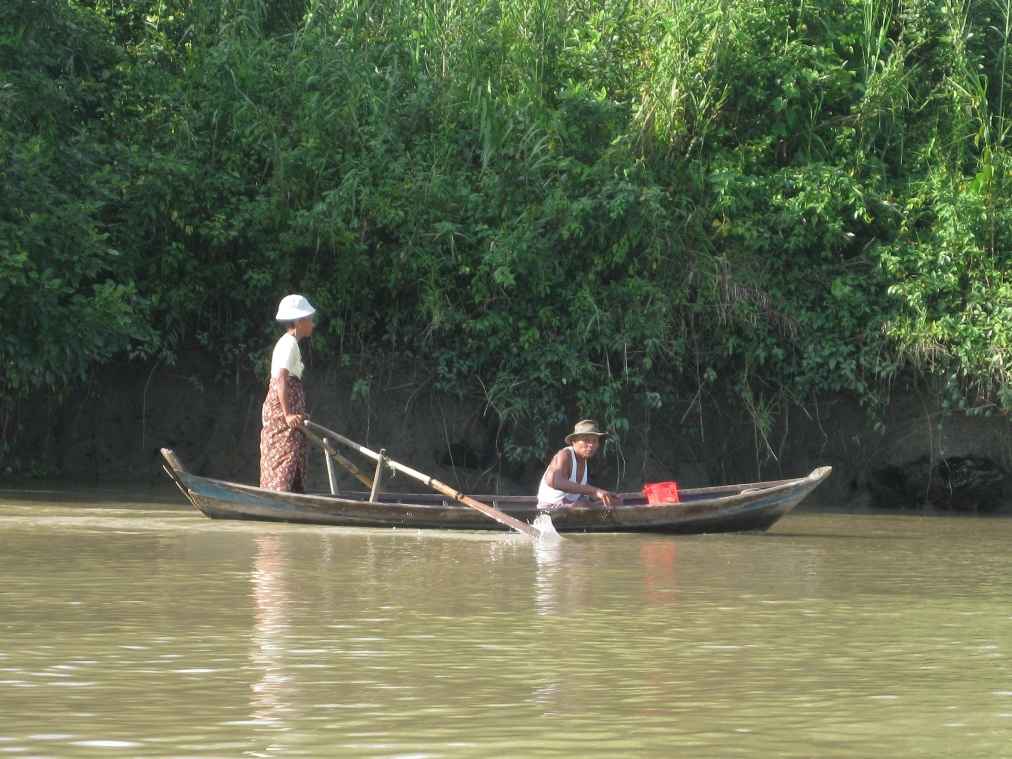
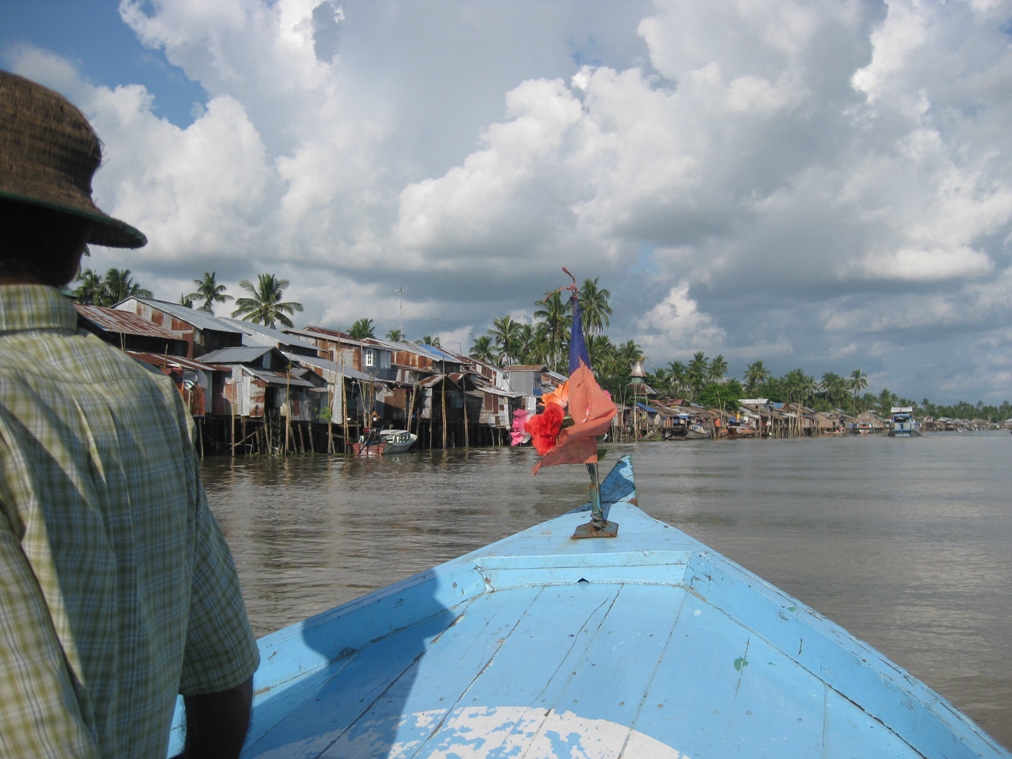
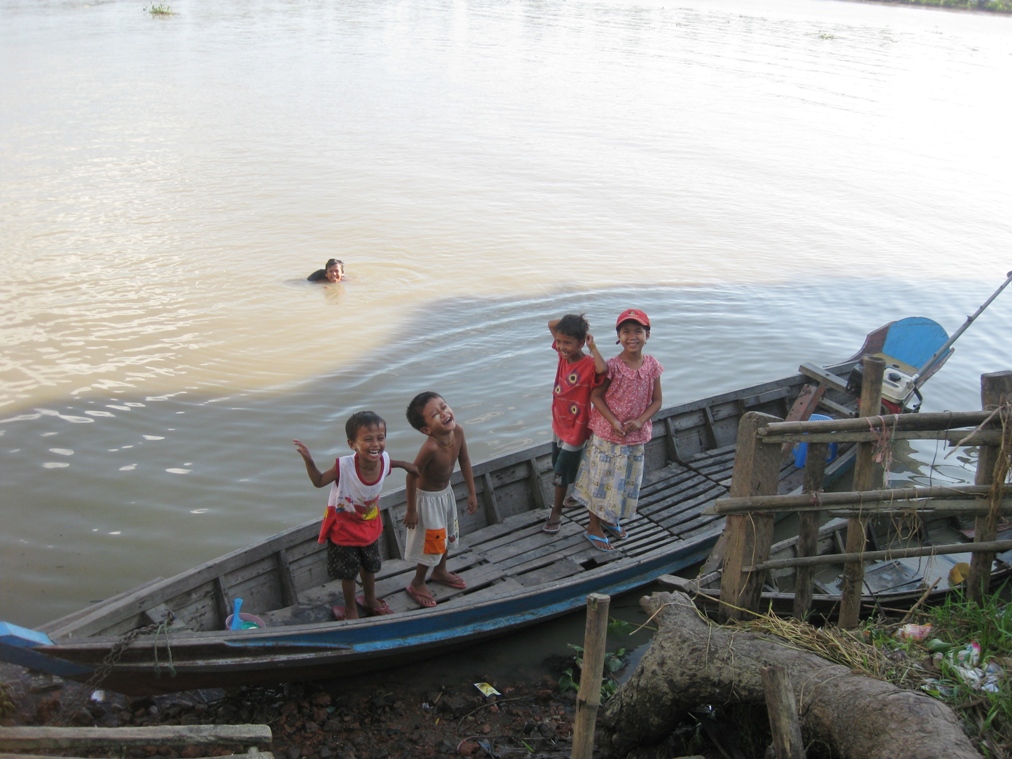
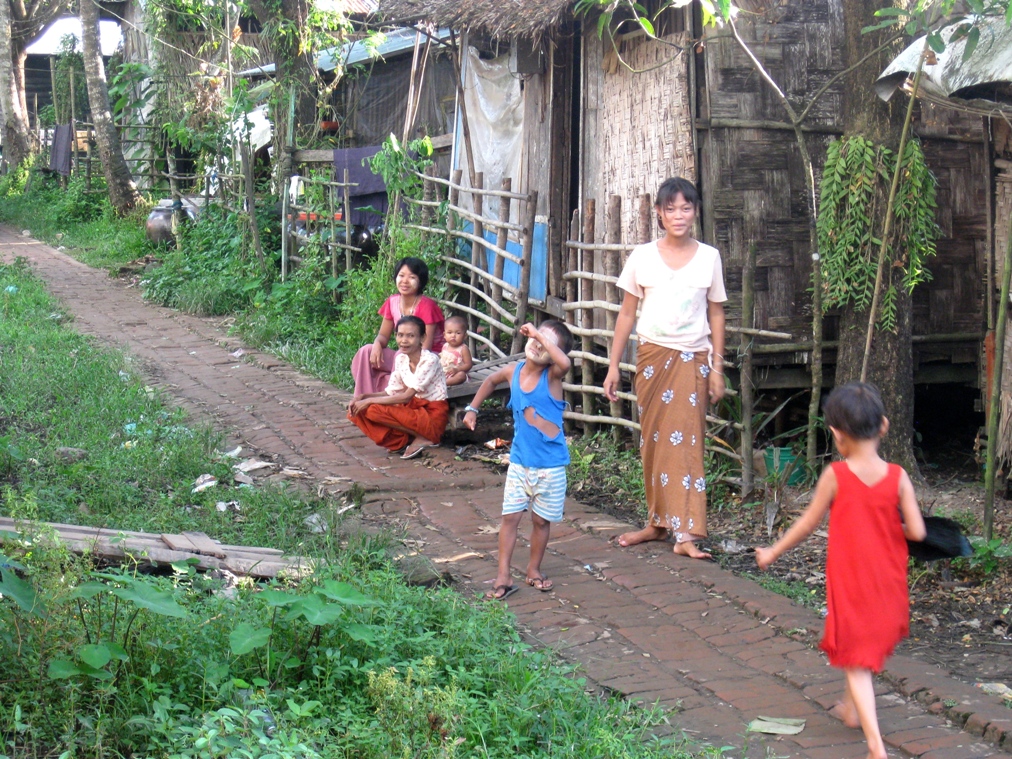
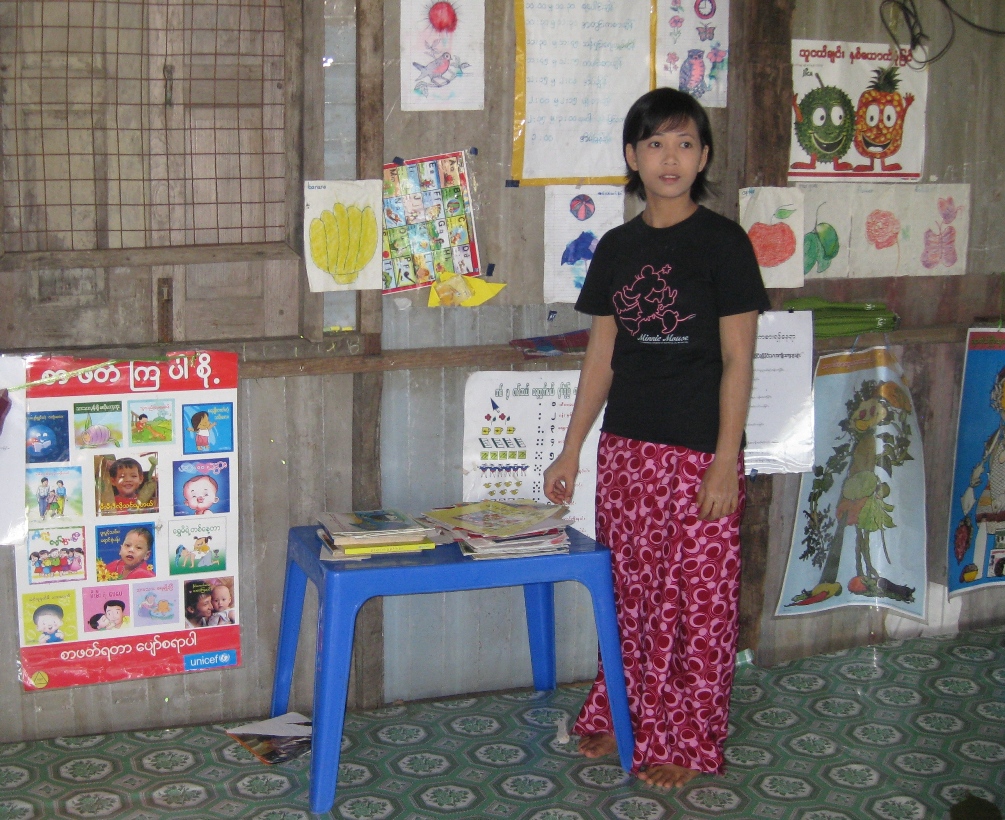
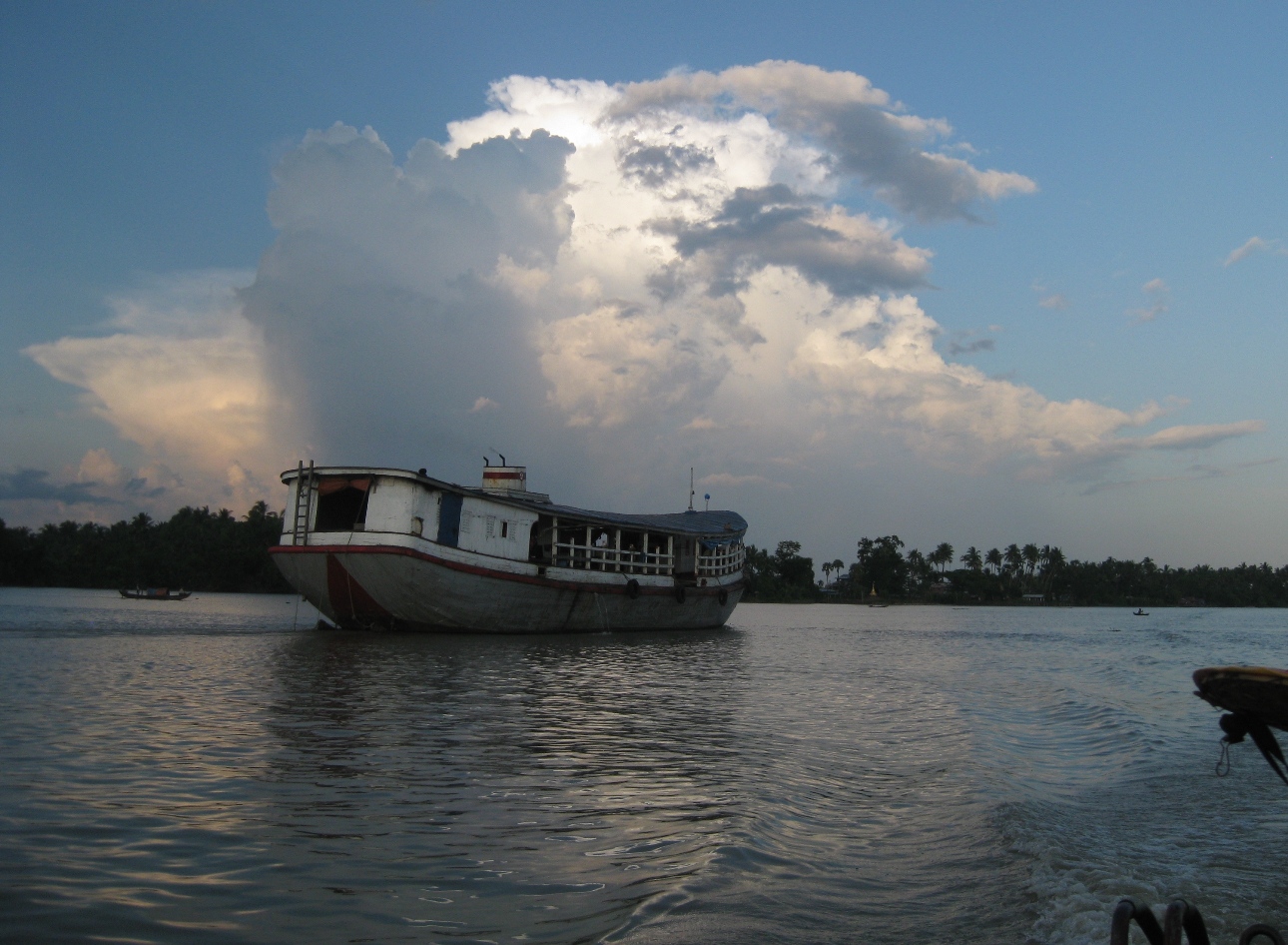
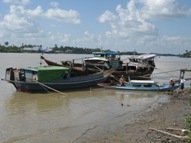
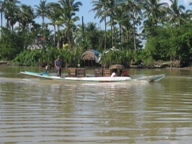
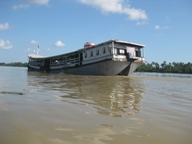
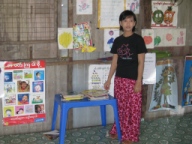
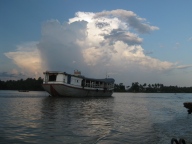
The river trip was made in a small boat shown in the first picture below. It was provided by friends and education/library supporters U Aung Nyunt and his wife Daw Kyin Nu. We started out inside (see video) but soon got outside to better enjoy the scenery (see another video). Most small boats that are powered in Myanmar use a small Chinese once cylinder diesel engine with a long propeller shaft. I guess you could call it an outboard motor, but it is far simpler and cheaper (from $150 to about $300 for larger engines) than an outboard you would buy in the U.S. We traveled a few hours past many colorful boats to the river village Myin Ka Gone. The village had a row of houses along the river, and then a walkway which I think was its main thorofare. It may not have had road access, since this and a few other walkways were all we saw. One of the last pictures you see is a kindergarten teacher standing next to the school library. We plan to help them out.
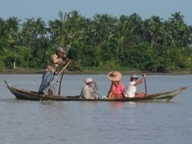
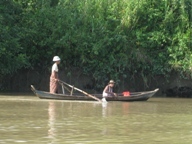
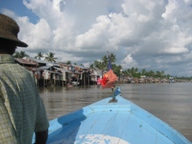
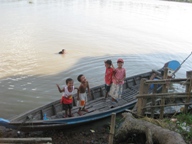
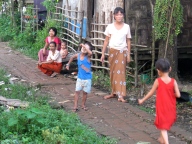
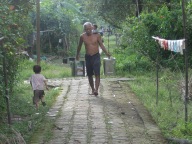
As we went on this and other expeditions in Myanmar, people from the local area helped us a great deal along the way. In Myanmar the people are always the best part.
Two weeks ago Sue and I got back from seven days in Myanmar, our fourth trip, and I finally have some time to write about it. The theme of this blog is coming to Thailand and the things that happen here, but one great thing to do when coming here is to take a side trip to Myanmar. The flight from Bangkok to Yangon (Rangoon) takes only an hour, and getting a visa is easy if you do it the right way.
Sue and I were there with to other board members of the Nargis Library Recovery project, John Badgley, Hector Rivas and Dr. Thant Thaw Kaung. John is an “old Burma hand”. He has been in and out of Myanmar almost since I was born. He knows a lot about the country and has many friends there. He also has a keen insight into the problems there and what can practically be done to help. Hector is CEO of the largest used book company in the world. He has a number of warehouses throughout the U.S. and sells on the internet. If you have ever ordered a used or out of print book through Amazon, chances are his company fulfilled your order (plug: you can get a better deal if you go direct – www.thriftbooks.com). Thant is our main Burmese board member, John’s counterpart in Myanmar. He manages our activities there.
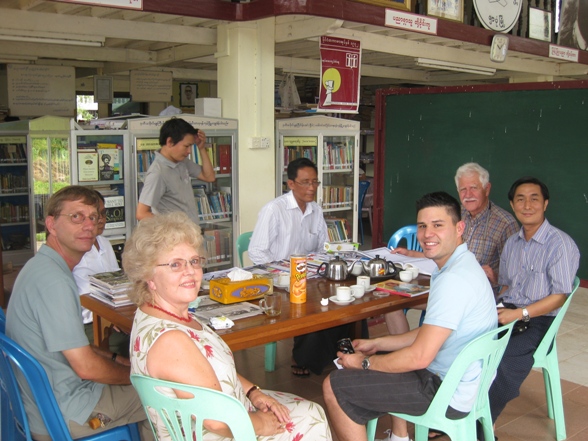
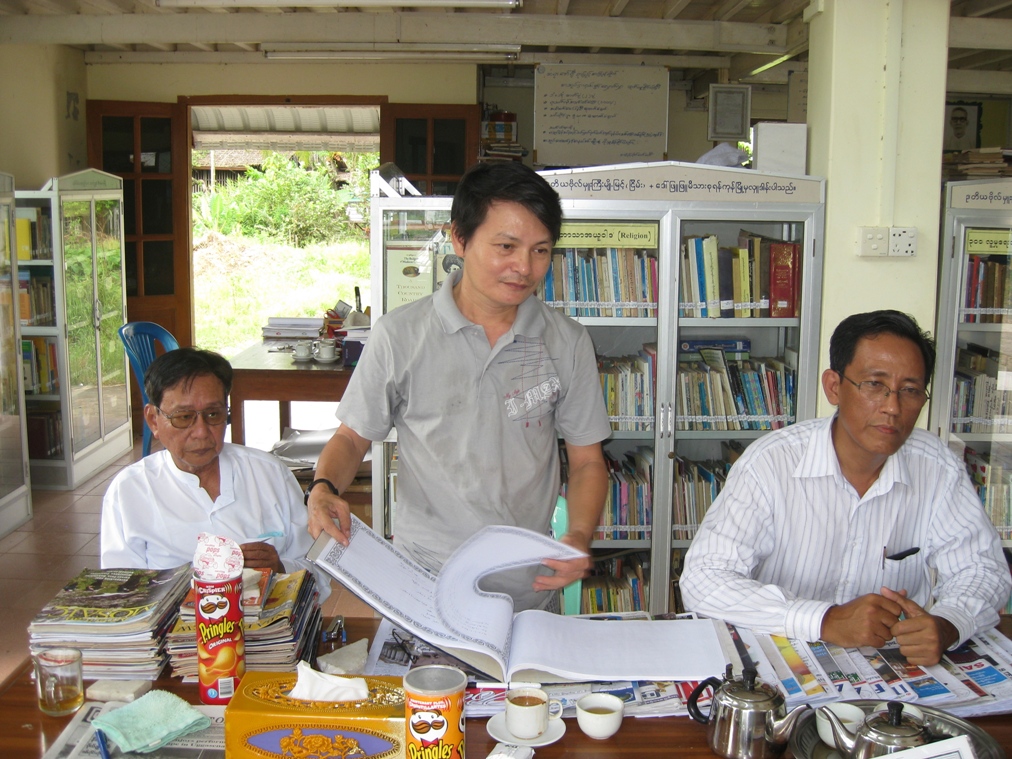
From left to right, Jack, Sue, Hector, Thant and John. The Bogale, Myanmar library board is behind the table.
This was Hector’s first time to Myanmar and he said he was a bit concerned about safety and what the government there might do to him if anything went wrong. After having been there a few days he realized that the problems he had imagined were simply not there. Those of us old enough to remember the grey pall that hung over the old Iron Curtain countries, how an American talking to a local person could result in that person being questioned or arrested, will be relieved to see that at least the appearance of Myanmar is completely different. The atmosphere appears very free and open, and will be that way if you follow a few rules that are easy for most of us: do not openly oppose the government, hand out anti government leaflets, etc. If you see some sort of political demonstration (we never have) go the other way. While the press has some limits, conversations between individuals is generally quite free and open.
The greatest danger to life and limb in Myanmar is the same as when traveling in any other country – a road accident. For Myanmar you are likely safer than most other places because there are fewer cars. When traveling south of Yangon it was common for us to be the only four wheeled vehicle on the road, with maybe one or two motorcycles within view and about fifty bicycles.
So what is Myanmar like? I think of it in contrast to Thailand. I was talking to a tourist who was just back from Koi Samui, a southern beach tourist place. He lamented that it was not like he saw it twenty years ago. Now it is high rise condos and high real estate prices. What if you could visit Thailand fifty years ago? That is what Myanmar is like.
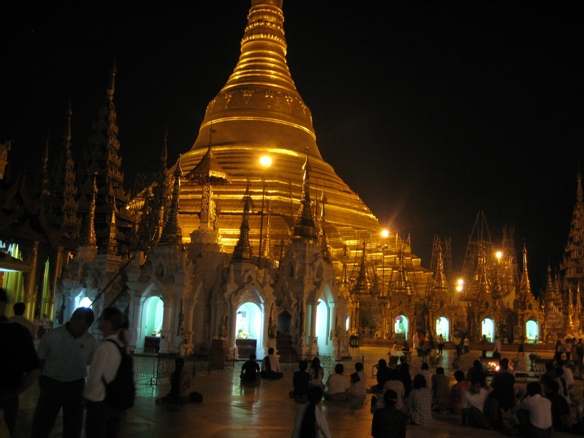
Shwedagon at night. You cannot come to Myanmar without seeing this.
The people are invariably friendly. The only place they might be a bit testy (one waved me off when I tried to take a photo) might be around Shwedagon, the greatest pagoda in Myanmar. I can see that since one hundred percent of the Myanmar tourists go there it may get a bit old to some of the locals. Even there any problems are minor compared with anywhere in say, Tokyo or France. The Burmese people are uniformly thrilled to have Americans visit. There certainly are few of us that I have seen. I have run into a few Germans and other Europeans, but in my four trips cannot offhand remember any Americans that I ran into on the streets or at any of the major cultural sites.
The trip was only six days, but a lot happened. I will tell more in future posts.
Sue and I got back from Myanmar after a few adventures there that I will write about soon. Sue had to go off to India for a short time for teacher training and I am back up in Nang Rong.
It is good to be back. With November starting it is definitely cooling off. It was great out today. It threatened to rain in the late afternoon, but did not. If there is no rain tonight I can go out with Ho, one of our family fathers, and check on some positions the surveyors put in for our first child home two weeks ago.
Here are some pictures I took of our Opportunity Village area a little over a week ago.
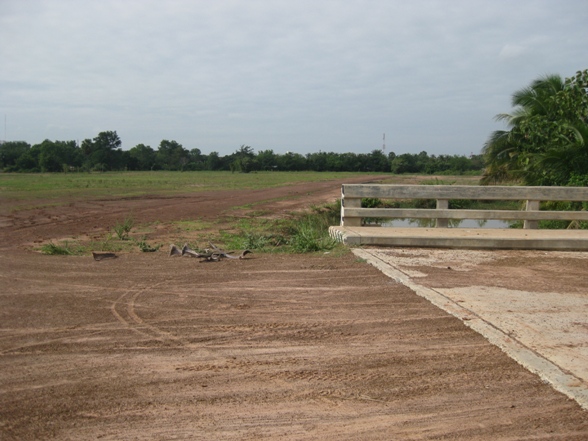
The property level is raised and some grass is growing. You see the road to the right as you come across the bridge. The new child home will go at the horizon of the grass at the picture center.
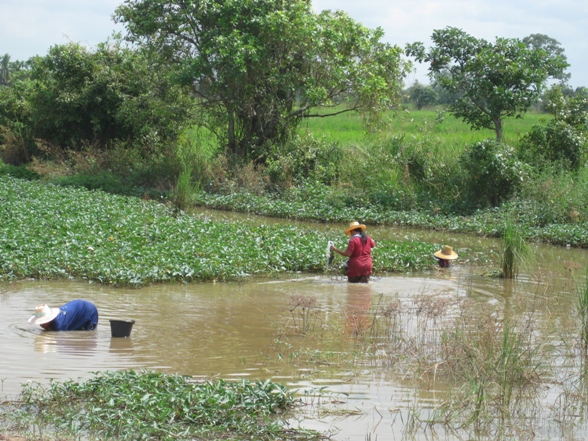
These three ladies are still growing rice on an unfilled area at the east corner.
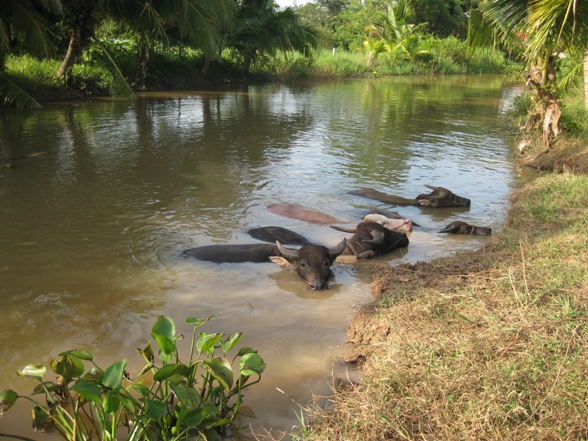
To the left of the bridge water buffalo cool off in the canal.
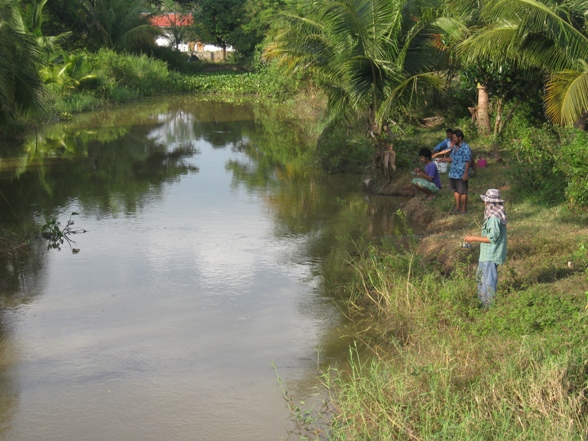
Later, some men come and fish in the same area to the left of the bridge.
One thing any Thai in Isaan knows is where to get the best Som Tam. If there is one particular food that they eat here it is Som Tam. It’s main ingredient is green (we westerners would say unripe – but what do we know?) shredded papayas. Some other ingredients I can remember are prik ki nu (the peppers that can make it very spicy/hot), peanuts, maybe some long beans, a couple of small tomatoes, a few lime halves with the peel thrown in after squeezing, a few garlic cloves, dried shrimp and fish sauce. They often put in bpara which is some kind of fermented mudfish. My daughter in law who is currently in the U.S. translates that to “smelly fish” because if she ever cooks any it has to be outside, since my son can’t stand the smell. I can’t either, for that matter. Finally they throw in a spoonful of sugar and a spoonful of MSG.
What everything is thrown into is called a croc, like a big wooden pestle and mortar. They pound everything pretty well; put it all in a bag, rubber band the neck and you are ready to go.
Some of the ingredients, especially the bpara, can be an acquired tast. We get ours “vegetarian”, leaving out bpara, shrimp, MSG, most of the sugar and most of the peppers. It’s pretty hard for the lady to leave out all the peppers, so I let her put in two. This is Som Tam, and it’s supposed to be spicy. This places it at about level four of a typical Thai restaurant in America that has five levels of spiciness. If you ordered it spicy here it would be off the scale of an American Thai restaurant by a factor of three of four, so be careful. If you want to eat spicy like some Thais, break into it gradually.
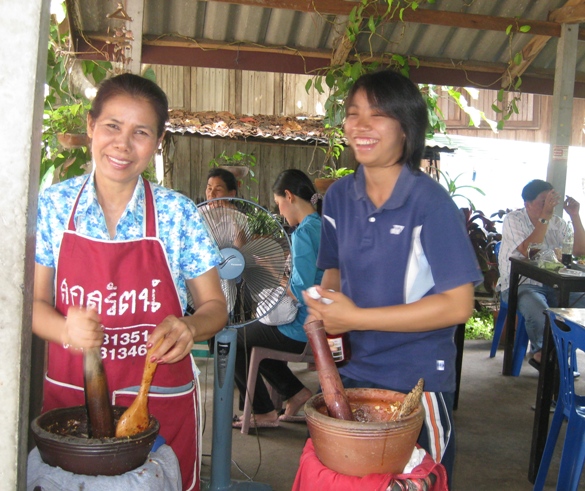
If you leave out the bpara and shrimp, have them wash the croc or your Som Tam will taste fishy. As the picture shows, my restaurant has two crocs, with the one on the right fish free.
What made me think to write this post was that I brought home some Som Tam yesterday, and when it was time for lunch today Sue asked me to go get some more. We really do like it, and Sue in addition likes the low calorie aspect.
View Nang Rong Som Tam in a larger map
So where is the best Som Tam? This is one thing on which everyone here has an opinion, even me. Some Som Tam places are definitely better than others. After the Som Tam lady whose shop was in front of my house left to take care of her mother I was getting it from a place down at the other end of the block, but it just was not as good there. Finally the lady living to one side of me and a guy across the street both informed me of their favorite place. I tried it and agree it is the best. It is on 348, the north/south highway through Nang Rong.
September 27th, 2009
admin
Sue and I are getting ready to leave October 6th for Thailand. We have done this enough that it is pretty easy for us now, but I did call our county health department, where we get most our vaccinations, to see if we were up to date.
Everything was OK with nothing to do this time. What they checked for was hepatitis A and B, tetanus and typhoid. The hepatitis vaccination lasts for life, but the other two do need to be renewed periodically. Visit our website to see other things they might have checked for but are rare enough that in our case they did not bother.
We are not bringing Malaria pills. We never have. Don’t bother with these unless you are going somewhere none of us at the foundation have ever been. While you can find malaria in Thailand, you have to work hard to do it. In addition to Thailand, Sue and I spent a lot of time in Indian slums over the past 10 years and have never bothered with malaria meds. We will spend a week in the cyclone ravaged Myanmar delta area next month and will take some mosquito repellent, which we have never used in Thailand, but that is all. We are staying in small hotels at night. Sleeping outdoors in that area is unnecessary and not a good idea.
The Thai government and military have a mosquito abatement program that appears to work well. There are very few mosquitoes around Nang Rong, and few of those could infect you with a disease. Over a five month period I will get maybe two or three bites.
You really should get these immunizations. I remember one problem at a local restaurant that gave hepatitis to over a hundred people. I have also have had cuts and stepped on rusty nails which everyone knows leads to a tetanus shot since most people have let whatever protection they have had in this department lapse.
One thing is common to all these incidents. They happened in the U.S. The town with the restaurant hepatitis problem was Coeur d’Alene, Idaho where I am now. Our local health department knows that these vaccinations are good to have wherever you live. If traveling scares you into getting them, fine.
Whether you plan to come here as a volunteer or not, whether you will come next year or five years from now, go to your local heath department, tell them you are coming to Thailand, and get your shots. Anytime is good.
September 18th, 2009
admin
Well, I finally visited a local Thai restaurant. That is not unusual in Nang Rong, where virtually all restaurants are Thai restaurants. In this case, however, I was in North Idaho in the U.S. where Sue and I spend summer. A Thai restaurant opened its doors here a year ago. My daughter in law Add, who is Thai, works there as a waitress, so eventually I had to show up.
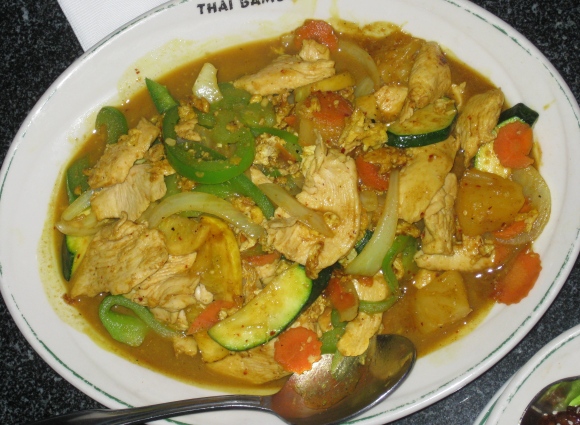
For me it was good, maybe in the top half of restaurants in this town, but not great. The first time it was chicken in a yellow curry sauce, zucchini, bell peppers, a bit of onion, carrots and pineapple chunks. The chicken was good, but not really different from chicken at other restaurants. The sauce was OK but I have certainly had better. Bland?
The second time it was Mongolian beef. I have had better at some U.S. Chinese restaurants but the closest is a five hour drive from here. I’d rate it as very good for here and was told it was a popular dish. The glaze on the beef was good.
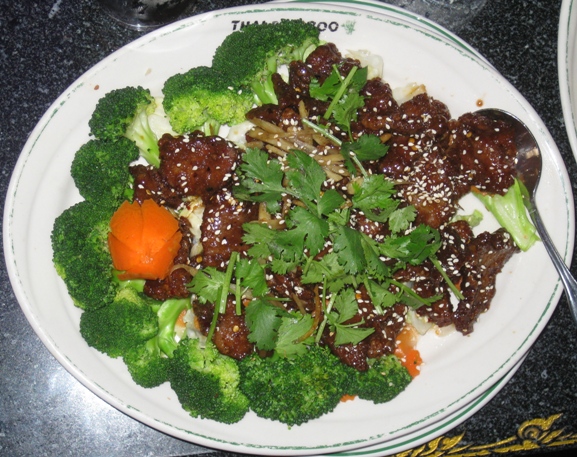
There was three times as much meat, twice what I could eat, compared to in Nang Rong. As a leftover the glaze soaks in or changes and the Mongolian beef loses a lot. Split this dish with someone.
They have five levels of spiciness. If you eat medium spicy in Isaan go for five and you should at least notice it.
The big overall thing was the rice. I was coarser, like rice at any normal American restaurant, like rice I grew up on in the U.S. I don’t like it. Maybe most here do? In Isaan they use Jasmine or the like that cooks up softer, a little more “melt in your mouth.” Add said the owner preferred to save money by using U.S. rice. Notice the chicken dish also saves by using green bell peppers rather than the more expensive, colorful and slightly tastier yellow and red. This restaurant leans toward the upscale (the décor is best I’ve seen in this area of nearly 100,000) so I expected a bit better.
For me the rice made all the difference. I don’t think he saves much. I get Thai Jasmine rice in a 25 pound bag inexpensively at Costco. My wife as well as Add use it when in the US. Does living in Thailand make one become a rice bigot?
Will this make a difference to most diners here? I don’t think so. They should give it a try. I spent a month in various parts of China and in general (there were a couple of shining exceptions) I like Chinese food in the U.S. better than that in China. I also like pizza here better than that in Italy. But when it comes to Thai food, I’ll stick with Thailand.
In case you were wondering, Sue and I arrive back in Thailand October 7. We would not miss the dry season.
September 13th, 2009
admin
The CNN news story today about Guatemala is the worst adoption abuse I have yet seen. International adoption can be great for a child with few other options, but the temptation for some to abuse this system is so great
A local adoption occurs when a child of Thais that is adopted within Thailand usually to Thais. This is much easier than the second kind and usually does not involve a lot of money. Often a parent of the child is available or can be found and signs off the adoption. Since adoption is a legal transaction, there is no way the government cannot be involved, usually at the provincial level. It’s pretty clean and relatively easy with everyone working for the good of the child, at least in our experiences.
International adoptions are another thing entirely. There are not a lot of these, numbers I have are 69 children in 2004, 59 in 2008. (You can check for various Thailand adoption regulations.) As in all international adoptions, a lot of money, at least by Thai standards, is involved. This invites abuses of the system. Lawyers, tests, interviews, pre placement reports, post placement reports, etc. I can’t blame the government for not wanting this process to go off the rails in any way, whether government corruption, abusive adoptive parents, or anything else that the tabloid news just loves to put in headlines.
After running across the CNN article, I looked a little more and found a blog article written in February 2009 which tells much the same thing, citing Guatemala as a worst case of international adoption abuse. Because of the article length I reproduce here its short comment about Thailand:
“Thailand, for instance, has a central government authority that counsels birth mothers and offers some families social and economic support so that poverty is never a reason to give up a child.”
Given this article’s anti international adoption stance, that is high praise. In fact, if I had to pick a country that comes out looking best in this particular article, it would be Thailand. It also talks about abuses of the system in nearby Cambodia, some of which was ended with reforms in 2001.
There are cases, although not many, that clearly allow for international adoption in Thailand. One is if the baby was abandoned and no relatives at all can be found. If the parents have died and there are no relatives who can or want to take in the child is another. Actually, the quote above implies that a birth mother, after counseling, can still decide to give up a baby. This is maybe a third. I need to check, but I’m pretty sure the government would check that she would get no incentive other than knowledge of a good home for her child. One more case can be the “failed” village abortion, where at times it is established that the mother (if still alive) REALLY does not want the child. In all of this there is also the assumption that no qualified family can be found in Thailand.
Child adoption is by no means our major activity at Opportunity Foundation, but we can be involved in it. We are preparing to assist the Thai government in caring for pre adoption children. This would avoid a stay of a year or more in the government orphanages which just cannot give the level of care we can. We hope to avoid developmental and other issues that can come with living in larger institutions. Don’t ask us about adopting a child, however! That is still done through the government and those NGO’s so empowered. We do not influence that process.
The Thai government keeps tight control over international adoptions, and from what I have learned, they need to. I would like to see some streamlining of the process so children do not have to be held so long, even if by us, before adoption can occur.
No, we try not to talk like that here at the foundation. Mark Twain said that.
Well, it happened again. The latest incidence of an NGO or its personnel wildly inflating problems or statistics to gain attention or to focus the world on the importance the problem they address. I have some interest in Myanmar and ran across this. Our foundation website links to a more comprehensive article about how the same thing happens with NGO’s working in Thailand.
In that article Alex Renton states that the evidence for trafficking and extreme abuse is more anecdotal than statistical. While I believe him, and can’t give you much in the way of statistics, what I can tell you is that the anecdotes do exist. I have met them. There appear to be enough of them to keep us busy and at this particular time make us wish we had the ability to take in one more child. Assuming we can reach it, will our end goal of being able to care for nearly four hundred such children be enough?
My guess is that it will not be. I’d give you some statistics to back that up, but right now I don’t have any.
I will certainly do everything I can to insure that statistics and information you get from here or our foundation website are true, or at least try to qualify what we say.