February 11th, 2011
admin
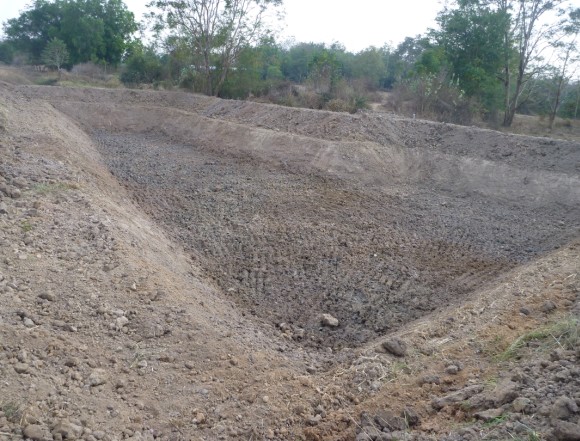 Our new fish farm.
We are digging a pond and using the dirt from it to build up areas on either side of the road where we are building our first houses. Eventually, of course, we will be bringing in a lot more fill dirt from the outside, since we still have to bring up more than half of our property by a meter and a half at some point. What we have already filled gives us room for our first sixteen houses, our main office/rest home/dormitory/school building and the volunteer apartments we hope to build someday.
It is probably awhile before we need to bring in more dirt from the outside, so digging the pond lets us raise fish as well as get rid of a couple of areas that can get marshy after the big rains. We’ll raise the same fish that we see for sale at the markets here. They seem to be the most popular with Nang Rong people and are not as cheap to buy as I would have expected. After I took the picture of the future pond, which is just to the outside of the circle road, I turned around and got our house with the pilings for the next house showing to its side. We will be building on these very soon.
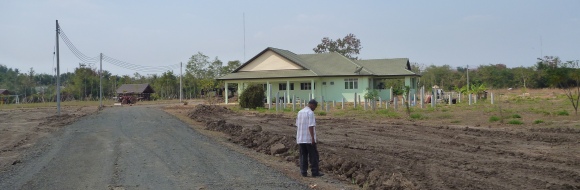 Rot stands in the circle road in front of a small “forest” of pilings. We’ll cut these off just above the ground and build our 2nd house on them. Note also the new low voltage power lines at the right of the picture.
I had some concern about our girls falling into the canal, and now we will have a new pond. It’s for the fish to swim in, not the girls. They are not allowed to swim in the canal, the water is to dirty for that. They won’t be allowed to swim in the new pond either, but you never know. So it’s been swimming lessons all around.
They have all already had five two hour lessons while I was gone for awhile. I’m told they did OK, but I’ll get over to the pool with them soon and check them out. We’ll see if each one can jump out into the deep end of the pool and easily get back out. If not we’re going to have some more lessons. Fortunately the girls don’t seem to mind the prospect of that at all.
 Our girls at their first swimming lesson.
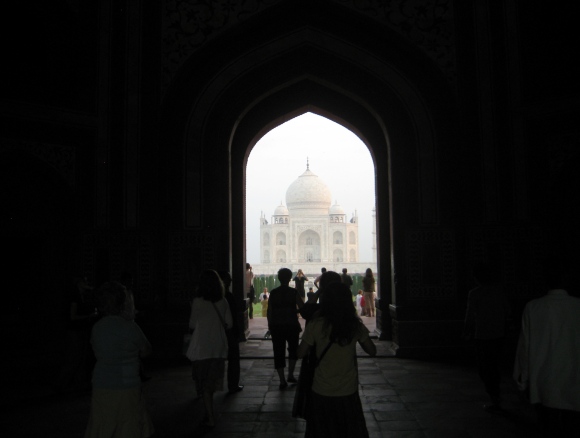 Beyond the entrance passage at 6 in the morning. There is nothing else like it.
The CNN article surprised me. Only 30% of Americans have a passport. These days that means that the others cannot even go to Canada or Mexico, let alone a more “foreign” place. I thought these days more people traveled internationally, or at least had a passport so if the opportunity came up they could go.
There is a lot to see in the U.S. I still have to get to the Grand Canyon, Mt. Rushmore, the Biltmore mansion… Still, what about the Taj Mahal, St Peter’s basilica, Angkor Wat, the trees at Ta Prohm, Bagan, Notre Dame, Sagrada Familia, the Louvre and the Hermitage? You won’t find those, or anything much like them in the U.S.
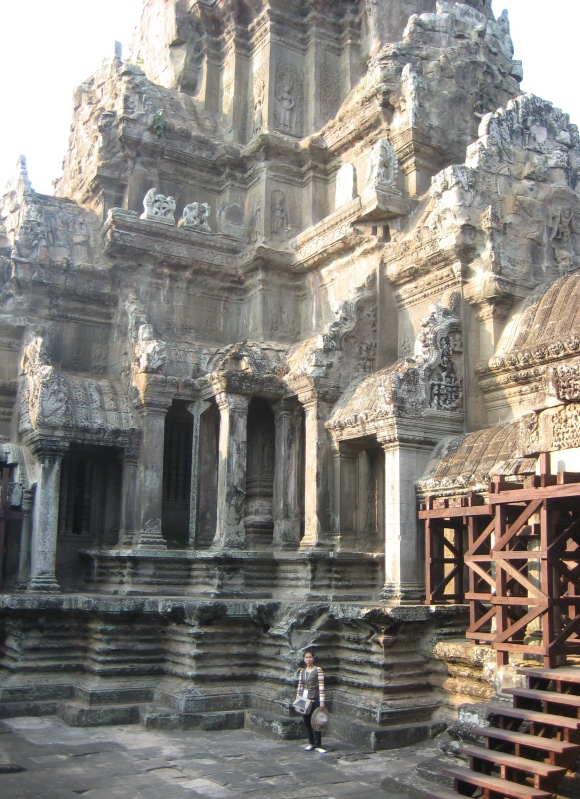 Our Thai friend Joy went with us to Angkor Wat. This place is seriously big, and only one of several other temples here. About $150 apiece, including two hotel nights, out of Nang Rong.
Then there are the other things. The slums in India, the villagers in Thailand and the school children in Myanmar. You won’t find those or much like them in the U.S. either. We have poverty in the U.S., but it can be very different other places. Some parts of it are pretty bad, but don’t think it’s depressing. Some of the happiest people I have seen have been in these places.
The article says many worry about safety issues, as the author states “What if I’m mugged in Thailand or kidnapped in a hostel?” The reality is, as I have already too often said, that your biggest fear by far is a vehicle accident, just as it is in the U.S. This is somewhat counteracted in that when travelling overseas you will more often be in buses rather than cars. In all our travels, Sue and I have gotten a scare only two times. The first was in Oakland, CA and the second in Washington DC.
If we are talking outside of Asia I suppose you should add to that pickpockets. In Europe I always carry most of my cards and cash in a pouch around my waist under my pants. I just have a bit of local cash and maybe one debit card for the local ATM’s in my wallet. I don’t bother with all that most other places.
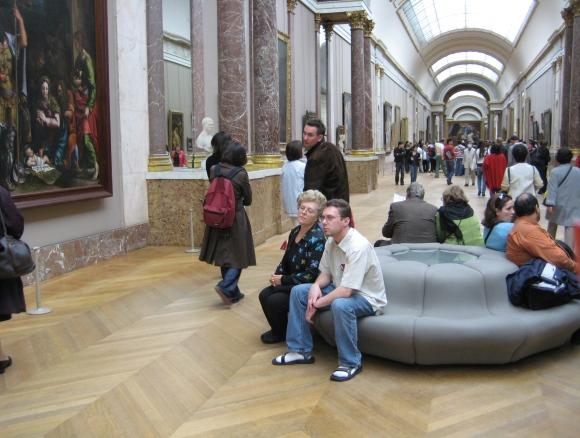 Jordan and Sue deciding what to see next in the Louvre. It took days… This week in Paris was inexpensive through go-today.com.
Calculate out the full true cost (mileage on the car, all the meals, etc.) of a week or two week U.S. vacation. You may find the overseas alternative very little more, or in some cases cheaper. Our method for European cities is go-today.com. They do the flights, hotels and transfers really cheap. And the hotels are usually right in the center of everything, not out at the edge of the city like the big Hiltons and such. After that you catch meals (except breakfast, which is often included), admissions and incidentals. Most travel in these cities is via subway, which is cheap and easy. We’ve been to traveling with go-today.com since 1996 and it has always been great. All it takes is a bit of money and a spare week.
In much of the rest of the world you pay the flight, but once you get here the rest of the trip is often much less than it would be in the U.S.
Think about it. At least get a passport if you don’t have one.
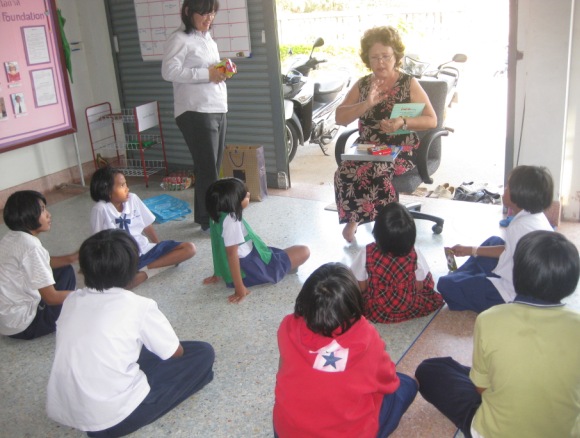 Sue teaches English to some of our girls. Walai is to her right.
I have been pretty busy with starting construction on two new child homes. Sue has been teaching English to our girls. She has been trying new flash card curriculum that the girls appear to like. The hope is to build some good methods so that “amateur” English teacher volunteers coming to us can be productive easily.
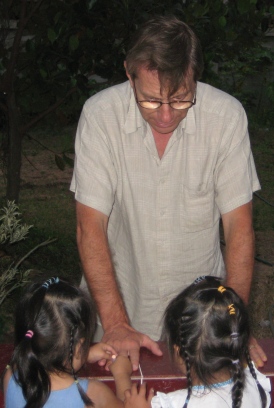
| Getting my nails done in crayon |
We visited our 2 ½ year old twin girls a few days ago. They are seriously cute. After having only sons, and then (so far) only grandsons, Sue likes to get caught up on little girl hugs. I even had my nails done. They were pretty skittish when they came to us a few months ago. Now they relate really well to everyone who visits.
I just heard that Buffalo Tours is coming this March with some volunteers to work in the village and with our girls. I’ll be here when they come this time. Their people come for a week, which is enough time to get the feel of our place and a bit of useful work done. They planted trees among other things last time. It was quite a large group. This second group will be smaller which may suite our level of growth right now. We are hoping a few of them might come back for a longer term to work with us some day.
Speaking of level of growth, we hope the contractors will start the next two homes next week or the week after.
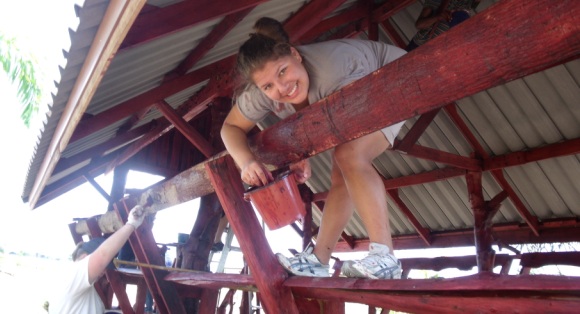 A Buffalo Tours volunteer working on our sala across the circle road from our first house.
 Left to right, Pisamai, Sue, Governor Samartkit, Jack, Walai, Ruut.
Last Thursday was visiting day. Sue, myself, Walai (our managing director), Pisamai (bookkeeper and office manager) and Ruut (construction coordinator and sometime driver) made the rounds in Buriram city, the provincial capital.
Our first stop was Khun Paiwaan, the director of social services for the province. She previously was a member of our foundation’s board for a couple of years to help us get started. She is now very helpful in our dealings with her and other agencies. We caught her between two speaking engagements so this meeting was short, but it had been awhile since Sue and I had seen her so it was good to see her again.
Khun Thanee Samartkit is the new provincial governor this year. A friend of Ruut is on his staff, so Ruut called him to see if we might stop by. No problem, Khun Samartkit was happy to see us. We discussed some of the recent “hot button” social problems in the province, one being the accelerating teenage pregnancy rate. He emphasized doing all that we can to keep mothers and their children together.
He has a point there. One factor of an NGO’s “success” can be how many children it has under its roof. This has on some occasions led a mother to give up her children simply because their education or housing might be better the institution. We’ll take kids if they are getting no housing, parenting or education at all, but just improving these things is no reason to take a child. A mother who loves her child is worth a whole boatload of that stuff.
The province is currently working new ways to support these young mothers so they can keep their children and we intend to participate in that effort. Better yet we’ll be working on prevention of teen pregnancies to the extent that is possible. It’s a pretty difficult problem, as many of us in the U.S. know.
If a child is in an abusive situation, only the governor has the authority to remove that child from its family to another guardian, whether that be a government agency, individual or our foundation. So if we something we feel is bad enough, he or his representative will be who we will contact.
Our final visit was to the Buriram shelter. We work closely with them and sometimes take children from them. In fact, we have a few right now. While they operate for the whole province, they do not handle long term residents, whereas we can.
It was a productive day of meetings, and we got back early afternoon in time for Sue to play language games with our girls, but that is another story.
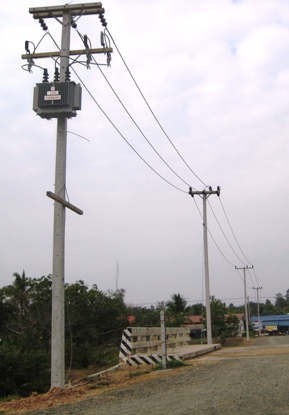
| 22 KV lines coming into Opportunity Village |
I have not had time to make any posts until now. Sue just took off this morning for three weeks in India. She will be evaluating teachers in the slum school and setting up for the next school year. She returns in three weeks.
I have been getting plans ready and checking on material prices for the two new child homes we are getting ready to build in Opportunity Village. I think the contractor will be selected next week. These first three homes are pretty large, and may eventually see duty as a crisis center for abused or pregnant teenage girls and an infant care center. The next homes we build after these will be smaller, holding up to eight girls.
High voltage electric power has been run along our access road and across the canal. We’ll soon run the low voltage lines into the first housing area that will eventually have sixteen homes. I would have preferred to run the power underground as is done in all new areas in the U.S. With new direct burial cable the cost of underground power in the U.S., even high voltage, is not so much. In Thailand, especially up in this area underground power is still pretty new and its cost is very high.
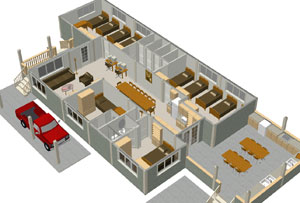
| Large house view. Click to enlarge. |
Today Uan and I hope to get out to some window and door manufacturers to check prices and sizes. I have to finalize the foundation piling position four our next houses (numbers 4 and 5). The pilings next to another house must be driven before that house is built, or the shock from driving might cause cracks in the concrete.
 Bill Cochran climbing up to the pier. Dennis Taylor and Thant still in the boat. Naw Maureen Kolay, WV director for Bogalay to the left walking up the pier. Notice the jungle at this landing is not so overpowering as at Auk Magyi.
While with World Vision we visited Koun Thee Chaung village. They have constructed a non formal education school here also. We visited the school and the separate small library building. This had more books than the previous school. 147 of them were from us.
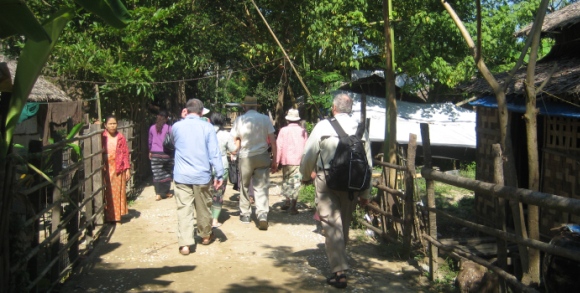 Our group walking down a village road.
 School to the left, library building to the right. These were both built by WV. They spent about $1500 for the library building and contents.
 Dennis, Bill and Thant look at the library books. 147 of these are from us.
The jungle was not quite so dense here as before. Cyclone Nargis hit this area harder than the previous place and ripped most of it out. This village had 1600 people before the cyclone. 600 of them died. We talked to various people whose families were devastated. It’s one thing to hear about it on the news and another to be there talking to them.
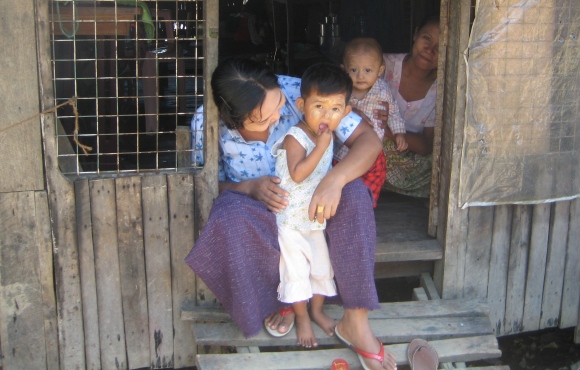 Did this family lose a child or husband to Nargis? I didn’t ask. Some we did talk to lost multiple people, both young and old, from a single family.
When I was ten I read a Life magazine article about a famine somewhere, I think in Africa. Life magazine relied on pictures to tell the story. Among them were pictures of mothers holding babies that had died, one of starvation while waiting in line at a feeding center. It was so overwhelming I came to the conclusion that those people just had to be different from us. If that sort of thing happened to the people I knew and was around we simply couldn’t take it. We would fall apart, go crazy or something. No way could we ever recover. As far as I could tell from the article and pictures they did recover, at least enough to go on about their lives. So they must have been different from me.
Of course as I got older I learned that inside we really are the same and losses like this hit us all the same. At that point the physical distance kept up enough space that a disaster way over there did not so much affect me as I lived in the US. For me it’s only when I get over there where these things happened and get to know these people that the full impact of the loss hits. Then I get motivated to do something.
Not that we should not do something right at home where we live. But in the US there always will be a substantial response to disasters. We lost lives in the thousands in Katrina and the World Trade Center, but our response in each case was in the hundreds of billions. Katrina alone had 60 billion in insured losses – losses you know were paid for. The total laid out was much more than that. In Myanmar from what I can find the losses are estimated at around 1 billion, maybe as high as 4 billion at the outside. But how much money is actually applied to them? Again, from what I can find it is in the hundreds of millions of dollars.
 Ever get the feeling you are being watched? I did all the time.
Again, my figures are approximate, and I welcome correction. What I see is that the money layed out for Nargis was around a thousand times less than for a US disaster in which about fifty times fewer people died.
Some of us need to help out with disasters in the US, but there is plenty of room for those who want to help elsewhere.
 Meet new people.
This and last year I have been talking about our trips to Myanmar to see the progress Nargis Library Recovery is making in getting books out to the people who have the least and need them the most. It appears we’ll be doing this every year around December – January when the weather is great and travel is not hindered by storms.
We visit temples and other points of interest, and we also visit a lot of libraries and schools. Those with interests in libraries, education and community development will enjoy this trip the most. It’s great fun and each year we learn a bit more about how things work, or don’t work, in Myanmar.
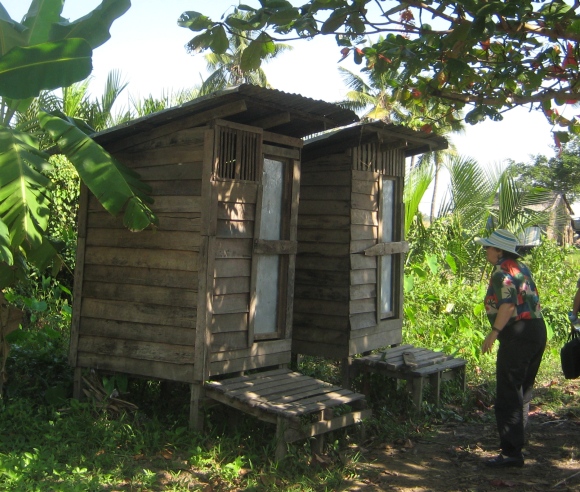 Closed for maintenance? Somewhere in the delta area south of Bogalay. There were working ones a hundred feet on up the trail.
The trip is not particularly strenuous. We’ve had a number of people in their late seventies and early eighties along with no more problem than anyone else.
The trip costs are paid completely by the travelers. Nargis Library does not contribute to these costs in any way whether it is a board member or other interested party coming along. This year the trip went from 8 December to 18 December and cost about $800 US per person exclusive of the airfare to get to Yangon. We also ask for a $200 donation to Nargis Library Recovery. This year three of our guests on our trip used that donation to finance the staff training and first two years of maintenance and staff salary of our new library at Thingangon. You can get bargains for both travel and helping out costs in Myanmar.
 We’ll visit the delta areas, some of which need special permit. Enjoy traveling on the water in Myanmar
You can inexpensively add on a side trip before or after. The tour operator we used will work with you on this. In a future post I’ll tell you how this year Sue and I followed this trip with four nights at the Amata resort at Ngapali beach for about $130 per night. If it gets more luxurious than that we don’t need to know about it.
If you are interested post a comment here. If you require more details than I can answer here I’ll email them to you. Also, you can always get more information at the Nargis Library site.
Myanmar is like visiting Thailand fifty years ago. While we are working hard to change that fact, at the moment it makes for a very interesting trip.
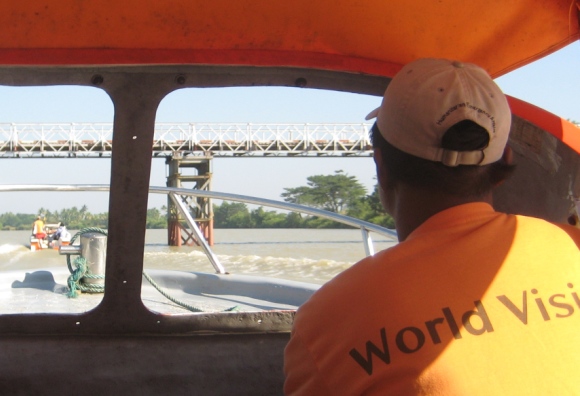 With World Vision heading toward “jungle schools” in the Myanmar delta. Part of our group is in the preceding boat.
Some aid gets to the people of the delta area of Myanmar. For every $50 in international aid, both government and non government, to Cambodia, Laos and Vietnam, Myanmar gets $2.50. I was told this by a “Burma expert” and later had to check it out with original UN sources for a magazine article. It’s really true.
This lack of aid is only partially due to the government restrictions on NGO’s operating in Myanmar. The other, and I think major, reason is due to the sanctions on Myanmar by the US, EU and Australia. Most NGO’s are from these countries, and sanctions discourage them. We (Nargis Library Recovery) had to get a special permit from the US Treasury department to do what we do in Myanmar. You don’t need that for other places.
In order to stay in Myanmar and do anything at all, NGO’s normally do not publicly complain about issues with the government. Sometimes a fuss is kicked up. You have to pick your battles. If you want to help political prisoners, monitor their elections for fairness or get government officials to do things differently that is one thing. If you want to help people in non political areas such as food and agriculture or education and libraries that is more straightforward.
By staying away from sensitive issues NGO’s can operate pretty free from government interference. The government does not bother with us. I think most of the money it gets from us is our 10% hotel tax and some airport fees when we visit. It does ask that we do not bring in books about Myanmar governmental issues, with explicit sexual content and religious books specifically aimed at proselytizing. It does not check our books, it expects us to do that.
Given all that, there are some NGO’s doing significant work in Myanmar. One of the best is World Vision. They have 850 workers in Myanmar, with 63 staff in the Bogalay delta area. Among other things they operate some non formal education schools out in the delta villages. Recently they have started helping us distribute our books among 50 libraries they either support or work with.
The Bogalay area director, Naw Maureen Kolay accompanied us in two of their boats to visit schools in two delta villages. These boats had the only two outboard motors I have ever seen in Myanmar. For small boats in Myanmar they were very fast, although most of the runabouts on US lakes would leave them behind.
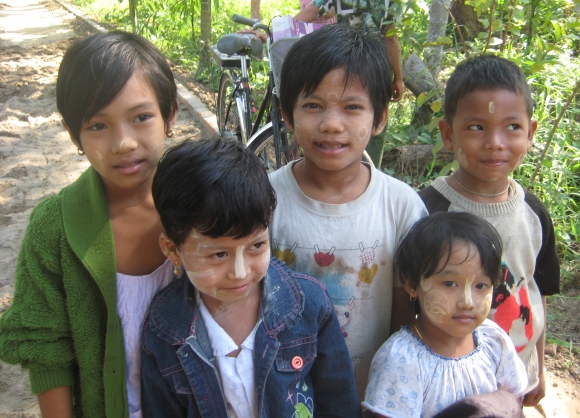
 Some school children await us at the landing at Auk Magyi village.
We could not see the landing for Auk Magyi until we were nearly on top of it, and climbing up to it was a bit of an adventure for some of us. The children and some staff members led us along a short trail to the school.
 Sue working with the kids. She’s now talking to WV about coming in with Gail, an Aussie master teacher, to do teacher training in the Bogalay area next year.
 A little help while leaving. School building is behind.
It is great that WV is setting up these schools for children who cannot go on a normal schedule because of their work load with their family. It is a great example of how help often must be given in Myanmar: you do what you can. It is not ideal and it could be much better if circumstances would allow. The kids come when they can. Often education is disrupted as the family moves to find work. There were only a few books here, some of them from us. They need both more Burmese and some English children’s books here and at the other WV schools.
 Naw Maureen Kolay, director of WV efforts in the Bogalay delta area, talks with Sue.
Way more should and could be done to help. In the meantime, NGO’s like World Vision, Nargis Library Recovery and about thirty others operating in the delta area will do what they can. While it may not be much, there is little enough going on there that it still makes a big impact.
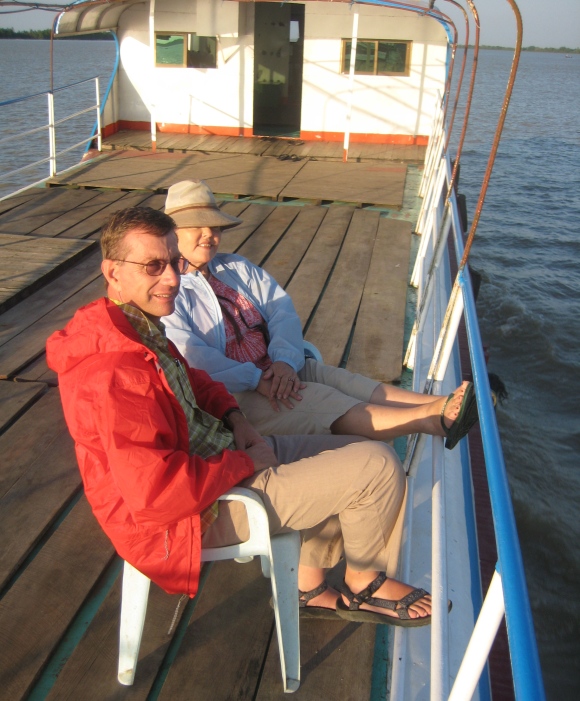 Sue and I enjoy river breezes on deck on the river ferry Yamone Aung.
In Myanmar, getting there is half the fun, whether on their hand crafted roads or on the river. Especially the river. Even though Thingangon was a major village (it even shows on Google maps, but in the wrong place) it was accessible only by boat. The nine in our party were based at Pathein, and required a fast boat to reach the island and return within the day. The only boat fast enough was a 20 knot 120 foot river ferry that normally transports 160 people. This allowed us a one way time of five hours. It was a bit pricey for Myanmar, about the same as renting a 19’ runabout in the North Idaho town from where I come, but our price included the fuel and the crew!
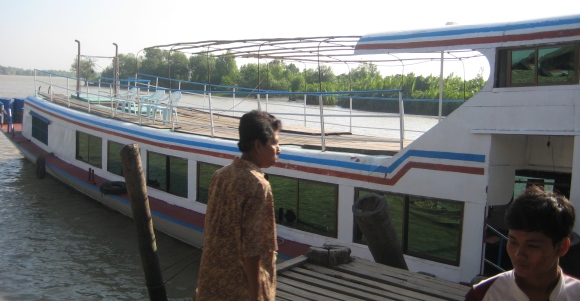 Our boat was too long! Throughout the trip I tried to get a photo of the entire boat. I never could back up enough to do it without buildings or too many trees getting in the way.
Even so, we had to start at four AM on December 14, which turned out to be a great time. It was still completely dark by the time we got away from Pathein. There were no lights of any kind along the river, and no light pollution visible anywhere in the sky. This is one nice thing about being in a country which has large areas without electrical power. There must have been a meteor shower going on, because some in our party saw six. I saw four, as many as I saw near Waco, TX when I went out to see the Perseid shower earlier this year. I never could get away from the light pollution of Waco or nearby towns that time.
I just checked on the internet, and found that the Geminid shower peaked the nights of Dec 13 and 14. How about that? The first time I’m in good night seeing in years.
The first few hours in the dark were definitely the high point of that trip. I could see many more stars than I could even in Thailand. I don’t remember stargazing like that since I was a kid out in the country in North Idaho. The weather at that time was a bit cool due largely to our 20 knot speed, requiring a windbreaker. Once the sun was up for awhile we no longer needed the jackets.
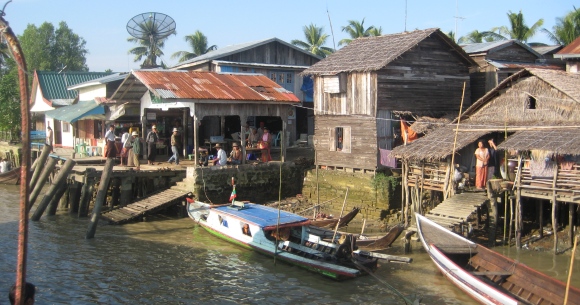 Coming into the village where we took a morning coffee break.
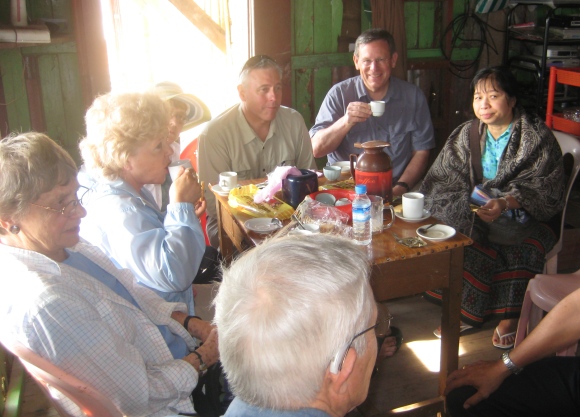 Inside the village “coffee shop” on the pier. Clockwise from the foreground. Dave Leuthold, Carolyn Leuthold, Sue, Lyda Adair, Bill Cochran, Dennis Taylor, Daw Ah Win. Arm in the lower right supplied by Dr. Thant Thaw Kaung.
After sunrise Sue took a nap on deck. We passed a few small settlements, but only one or two of what I would call a small village. We stopped at one of these for morning coffee and a snack, after which we resumed our trip to the far south.
When we got to our destination there is only one boat landing which already had a boat at it, so we tied up beside and debarked through that boat to the pier. After a short walk out Nargis Library Recovery group arrived at our first new library building, which I describe in the previous post.
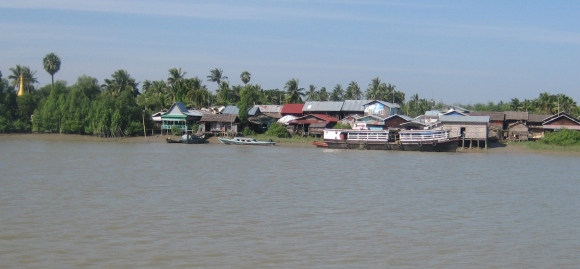 Thingangon Village. We landed through the open area in the center of the large boat on the right.
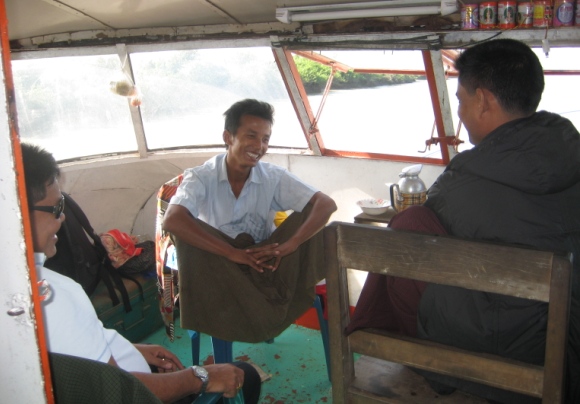 Our captain and crew.
The return trip got us back to Pathein after dark, in time for a late candle lit dinner under the stars and then to rest for our next day with World Vision to the east.
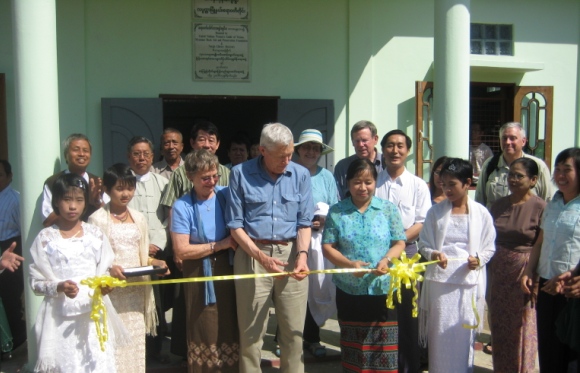 David Leuthold, chairman for Nargis Library, and Daw Ah Win from the donor group cut the ribbon for the new Thingangon library.
I have used this title before. Sue and I again went to Myanmar and visited a number of libraries supplied by Nargis Library Recovery as well as our first new library building. The building was opened in Thingangon which is very close to the southern end of the delta area, downriver from Pathein. The building is in a village of seven thousand on Middle Island, a large island in the delta. The library serves the entire island of about forty thousand people.
Pathein, Thingangon and Middle Island can all be found on Google maps, but both Thingangon and Middle Island shown there are not where we went. First find “Pathein, Ayeyarwady, Myanmar” then look due south and about two thirds of the way to the ocean you will see Labutta. Thingangon is in the Labutta township and is southwest of Labutta on that same finger of land.
After our boat delivered us to the pier, a few minutes walking through the village streets brought us to the new library. The second plaque above the door says “Donated by United Nations Women’s Guide of Vienna, Myanmar Book Aid and Preservation Foundation and Nargis Library Recovery.” The first of these three is a group of Women from Vienna who donated $8000 to us. This, along with local help for labor and some materials, covered the cost of the new building. Myanmar Book Aid is the Myanmar organization which is the counterpart to Nargis Library Recovery, which is a U.S. NGO.
Daw Ah Win, a native of the region and now a U.N. librarian in Vienna and member of the group who donated for the building, was traveling with us. We met with the local library board and had a ribbon cutting ceremony to officially open the building. You can read more details about this library here. Now that the building is built, we will do what we have been doing elsewhere in Myanmar, supply books for it.
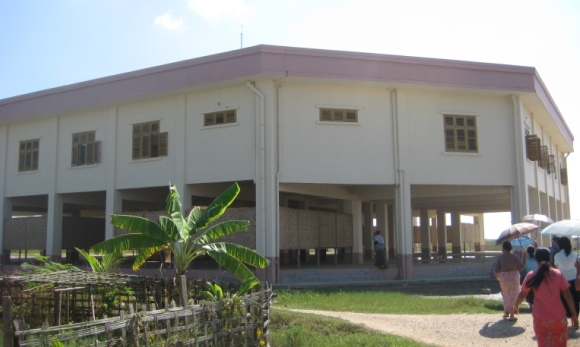 Thingangon cyclone shelter.
Thingangon is one of the places where the government built a large cyclone shelter, so this area was hit by Nargis with considerable loss of life. The shelter is built on very sturdy columns so that flood waters can flow underneath while the people are protected on the second floor.
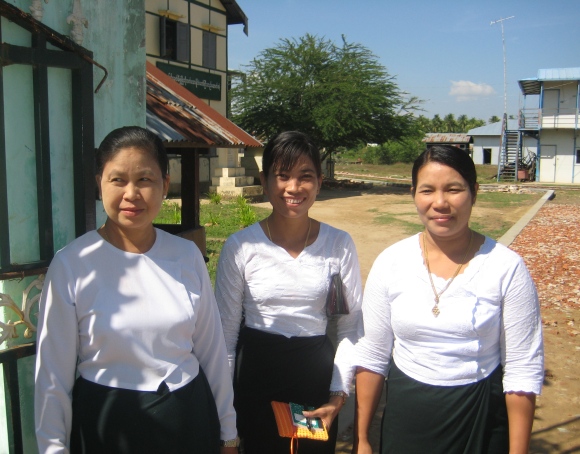 Some teachers at the school gate.
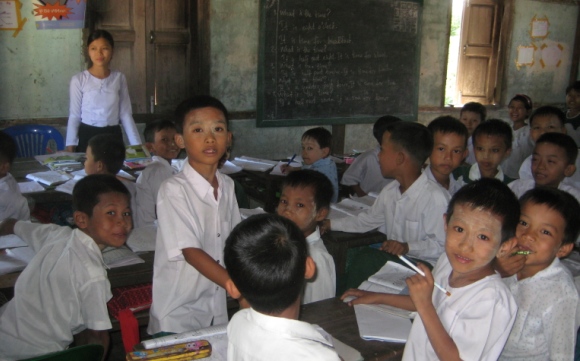 A boys classroom in the school.
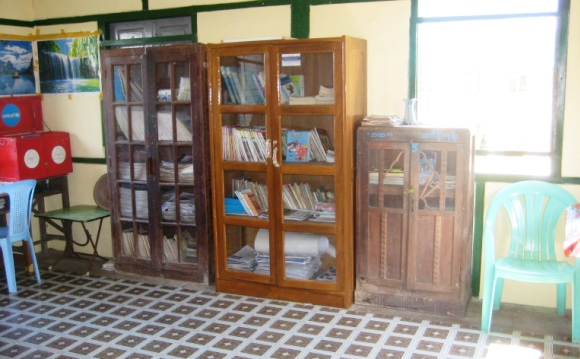 The school library.
After visiting the shelter we went to the school that serves this and surrounding villages. It has three buildings for elementary, middle and high school. We visited some boys classrooms and got a good reception from the students. The library for these schools was housed in a couple of cabinets. For English I found about six copies of one book “Money for a Motorcycle”. We’ll have to get more books to this school as well.
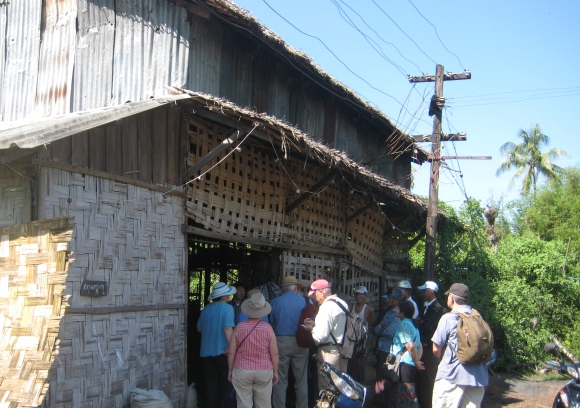 Village power plant fired by burning rice husks.
Before leaving we visited the power plant that supplies electricity during the evening hours. This will allow our library to stay open until 10 PM.
We had a great visit. All of us, especially our four new people, returned with a better sense of the needs of the delta area and how the little we have done will be stretched to serve a large number of people.




