I just posted an article on scams in Thailand. There are scams related to taxis and tuk tuks, but taxis in Bangkok are a whole subject themselves. I use the sky train, subway, canal boats, walking and the standard air conditioned taxi-meter as the best ways to get around in Bangkok. I have a car here in Thailand. If I do drive it into Bangkok I leave it at the hotel until I am ready to leave Bangkok. I just don’t like driving in the city, and gas is expensive. I’m not sure I save anything by using my own car in Bangkok.
Taxis are cheap here, and they are versatile. The other transportation forms I listed are limited in where they can practically go. The Taxi can go anywhere – at least once the flood waters recede.
Everyone wants to ride the tuk tuks in Bangkok. By all means do so, once. They charge as much as an air conditioned taxi and may be hard to dissuade from stopping by their friend’s jewelry shop on your way. Once there you can participate in a scam so famous it has its own Wikipedia article.
A standard taxi tuk tuk has a yellow license plate, like a normal car taxi. The privately owned tuk tuks have a white plate. I’ve heard the greater portion of the scamming is done by those with the privately owned ones.
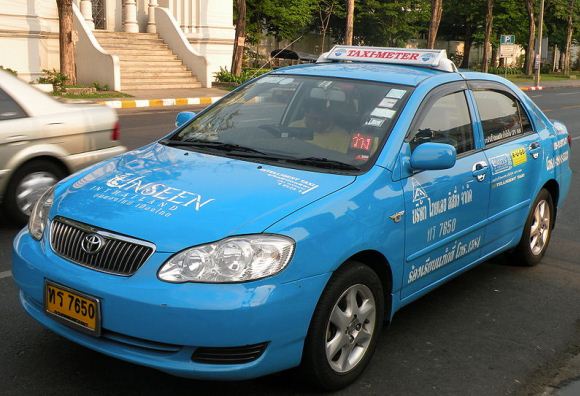 A Bangkok Taxi. They’re not all blue, but all should say “Taxi-Meter” on top. The lit up sign in the windshield on its left means he is looking for a fare.
The best way to get somewhere in Bangkok is with a standard air conditioned taxi. They’re usually cheaper than a tuk tuk for any trip and can take you much farther if you need that. They should say “Taxi Meter” on the top. They should use the meter. I ask them to use it before or as I enter. If they won’t I just get another cab. Otherwise negotiate the price before you get in. Also tell them your destination, or show them a card (in Thai) that your hotel desk clerk made up of your destination. A particular driver may not go to some areas.
At a bus station or the airport, don’t go with anyone who approaches you regardless of their uniform. Their price will be more than double and your ride less secure. Always ask for the “taxi line”. These lines have never taken more than about a minute for me, and the taxies will use the meter. If you don’t see the red lit up meter numbers, point to the dash area and say “meter! meter!”.
Be aware that there is an additional charge, about 50 baht, if you get a taxi in the meter line at the airport. This is what the airport charges the driver. There is no charge like this if you are going to the airport. Also, the driver often asks “highway?”, to which you can answer “highway OK” or just “no”. I normally use the highway when it is an option. Bangkok is famous for traffic jams and you may avoid some. The toll booths can charge from 25 to 65 baht, and you may go through one or two on a typical trip. The normal custom is for you to hand the toll money to the driver. If there is change he will normally give it right back.
Have small bills! You get to your destination and are in a hurry to catch a bus or plane and hand the driver a large bill. Guess what! No change! If I’m going to my hotel I don’t worry. I just tell him to wait and get change from the desk clerk. Another thing you can do is ask to stop at a 7-11 for water or something and break your big bill there.
If you need a station wagon or small van taxi for extra luggage, they won’t use the meter. Then you just have to negotiate the price up front. Beware, all taxis in Bangkok use propane. The vans have a big tank in the back taking up a lot of luggage room. You may not get as much in there as you think.
Some drivers speak English. Never ask a cab driver about a good restaurant. They will take you to their friend’s place. This may be situated where it is very difficult to walk away, and hard to catch another cab. Of course, after you eat their bad food at inflated prices, they will be glad to call you another cab. Better to find great places, and there are a lot of them, on your own. If you must ask, ask at your hotel concierge or desk clerk, not their limousine/shuttle driver, and you will normally get an honest, if not informed, answer.
If you tell the taxi driver you want to go to some shopping center and he says it is closed, either just tell him to take you there anyway or get out and get another cab. If the driver stops or wants to stop at a place other than your destination, tell him no, you will only go to your destination.
Check your wallet as you get out and as you move away from the taxi. Amazing how many people leave their wallet in a taxi. Especially during the confusing time of getting out, paying, getting your luggage, etc.
Tip: At the left above the dash is the driver’s name and taxi number. If you record that and discover a problem later it is really great to know. For some hotels (Holiday Inn did this) the bellboy getting your taxi will record this number automatically before your taxi leaves.
Tip 2: if you are leaving the airport and don’t have much luggage, go up to departures, go out and catch a taxi just as they drop someone off. I’m not sure they’re supposed to do this, but I have never been refused and save the airport fee. The driver is pleased with his quick turnaround, and is not unhappy when I say “meter!”.
Tip 3: It is usually easier to get a taxi you flag down (their front window red light must be on) to use the meter than one waiting in front of a hotel or some other place.
Tip 4: The propane tank in the trunk limits the cab to one large piece and one or two carryons there. Even then the trunk lid must be tied. Two of you can still get your maximum four large bags into a normal cab. I prefer two balanced on end in the front passenger seat using the seat belt to steady them, one in the back seat on end with us and one in the trunk. Some drivers will insist on only one in the front and two in the back seat with us. A bit tight but it still works. BTW I keep a small bungee in my carryon. Amazing how many drivers have nothing to tie the trunk lid down.
I just happened to run across articles about the “jet ski scam” today and realized I have never said anything about the scams here. Overall, things are safe in Bangkok and the rest of Thailand. Sue and I go to many areas of Bangkok both alone and together and never have any problems. Of course we have been approached by people as described below, but we blow them off quickly and go on our way without incident. There is no beach or city in Thailand, except the southern three provinces with Muslim unrest, that we would hesitate to go to. We have never hesitated to eat from any street vendor or street restaurant that sells what we want.
I suppose there must be some danger here, but it may be less than in the past because ATM machines allow the average tourist to travel around with just a bit of cash rather than the amount for his entire trip. It is extremely unlikely that any of the situations described below will become physically dangerous unless you let them evolve past your first encounter. Overall I am much more concerned in a US or European city than I would be here.
While you are not in danger, you will certainly feel bad if someone wastes your time and gets a bit of your money. Other than the jewelry, jet ski and airport duty free situations described below, whatever money you lose won’t be much, but it still ruins the good feeling of the day to get taken.
If someone who speaks pretty good English approaches you on the street or in a public place watch out! They may be a Thai, an American or a European. For example, they ask you where you are going, then tell you that place is closed today due to a special holiday, the king visiting, or whatever. Then they offer to take you somewhere else. Chances are 99% that the place you are going to is open.
If you are standing around looking perplexed, or looking at your map for a long time, a Thai who speaks good English may come over and be genuinely helpful. Do they let you ask a question and then try to answer it, or do they suggest you go somewhere you’ve never heard about? So evaluate before you act. There are good people here.
 Wall and gateway to the Grand Palace, Bangkok. Want to meet a scammer? Just stay outside this wall. Stand around looking perplexed. Maybe look at a map. Should only take a few minutes. Or, get along the wall out of sight of the gate and someone can come and tell you the palace is closed…
You just left the Holiday Inn and someone comes up behind you in a Holiday In uniform says he saw you in the hotel and suggests something, don’t believe them. They try all kinds of things to earn your trust.
If you are approached by a security guard or police officer who speaks good English you should be wary. Few police speak English, and those that do not very well. If you haven ‘t done anything, a normal police officer will not approach you. Rare indeed is it that a low paid security guard will speak English. Even though they may hang around and be friends with the regular security guards someplace, they are probably working a scam of some sort. If they say you can’t go into an area, OK, go somewhere else. If they want you to go with them, don’t.
Some of the “red light” areas of Thailand, such as Patpong near the Silom tourist area, are becoming popular street shopping areas. They are perfectly safe if you do not go anywhere with anyone who approaches you. Don’t go into a bar with them. Especially don’t go into an upstairs restaurant or lounge where you get away from the crowds. If you want to get into a dangerous situation in Bangkok, this is a great way.
Don’t ever rent a jet ski anywhere in Thailand! When you get back they will find damage that was already there and charge you for it. They’ve been known to use water soluble paint to cover defects, so if the machine is out of the water before you take it, you may still miss the “damage”. The amounts they charge can be in the thousands of dollars and you may find it very hard to refuse twenty or more Thais on the beach as they get very agitated by your arguments. It is common for them to actually restrain tourists from calling the police. If you do get to the police they may not help you at all. This scam is so widespread that you should never, never rent a jet ski anywhere in Thailand.
Never, never hand over your passport to rent a motorbike. It is common for them to ask for it, but your passport is really not your property, it is your government’s. If some guy on the street has your passport he has total control over you. When you return the motorbike and he wants 10,000 baht ($300) for a few scratches you may or may not have put there you may be stuck. Better to leave a cash deposit you can afford to lose. Unfortunately again, the police will usually side with such people.
Best to rent a motorbike from your hotel or guest house. The price should be the same, at least if it is a less expensive guest house. I have never had them ask for even a deposit.
You may need to give the hotel desk clerk your passport when you check in. They make a copy of a few pages in it and give it right back. Otherwise, except for some government agencies and embassies here, I have never given my passport to anyone.
If you rent a car, use a known brand company. No telling what kind of “pay for damage” or other problems you could have otherwise.
If an old lady or other non threatening person puts something in your hand or on your bag, such food for pigeons, give it back immediately. If they won’t take it put it on a bench or the ground and walk away. She will often have a partner who may be less “non threatening”. If worst comes to worst start raising your voice, make a scene. This is the height of bad manners and impoliteness in Thailand, but they should not arrest you for it. Attracting attention is a good way to rid yourself of scammers.
If you smoke, don’t throw your cigarette butt on the ground. The police watch for that and can ask for a 2000 baht (about $65) fine. Often it is a scammer and not a police officer, but it can be hard for you to tell. This applies to other litter as well. If they really are police (wearing a real gun) you can often talk them down by a factor of five or more. This can be a tough one, since in Bangkok and major cities there are no trash receptacles. The only ones I have seen are sometimes at the top or bottom of an escalator and in restrooms in the shopping centers.
A number of people have reported being charged thousands of dollars in fines for shoplifting they did not commit in the upscale duty free shops in the Bangkok airport. The police come and search them and no goods are found, still they are charged and cannot leave the country until they pay, often in the $10,000 range. I think any of the other areas in the airport are quite safe, but I stay out of the duty free shops or any airport shops with high priced goods.
I want to talk about taxis in Thailand (mainly Bangkok) and related issues and scams. That is for another post.
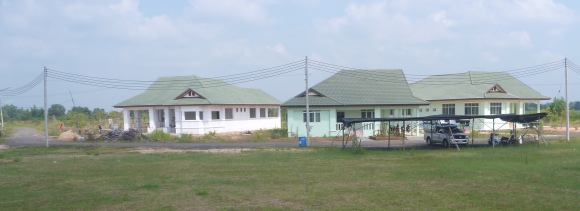 Our three child homes. Just finished on the right, finished next month on the left.
You can see the road coming in from the bridge on the far left.
We have just completed our second child home (right in the picture) with one of our families to move in in a few days when some beds and furniture are completed. Our third home (on the left) finishes next month. We’ve been trying different contractors, and while the homes are essentially the same some of the details have come out differently. Even with one family, it has been really different being able to live in the village. As far as I can see, the differences have all been positive. By the end of next month, all will be here, including our crisis center people.
 Chow line at a birthday party in our first child home. Son Nathan is standing with Pissamai our bookkeeper. Some of our elderly and staff to the right.
Homes are built differently here than what I am accustomed to in the US. First of all, it’s all concrete post and beam. You can build a home from wood. They’re more expensive but really nice. It can be a constant fight with termites and other insects. This climate makes things harder for a wood structure and other wood materials. In addition, they don’t have many fast and straight growing pine and fir trees to get framing lumber from like we do in the US and Canada.
 Finished counters on the back porch of the just completed home. The wooden door frame/door units can be bought in different sizes and types at a building supply store.
 Counters at the back of the third home before tile and doors. The sides are made from small bricks covered with some kind of plaster/concrete.
This even goes to the kitchen “cabinets” which are made from concrete and ceramic tile. I should tell you that our kitchens are somewhat open to the outdoors, but this is done even for completely interior kitchens. Tile is fairly inexpensive here. Everyone seems to use it for about everything, including counter tops, the sides of cabinets, the entire wall of a bathroom and all floors. You can buy normal cabinet modules here. You would still have to put a counter top on them, which here would be tile. The concrete and tile cabinetry they do here is way cheaper.
An earlier post tells about the construction of these homes.
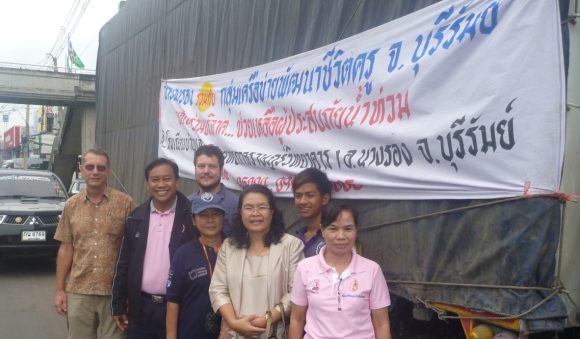 Here we are ready to leave more than 4 hours late. My son Nathan is with me in the back. Tasanee in the light beige jacket. The others are teachers and one of our teenager loaders.
I just got off the phone with Mom. She’s seen the news reports about flooding in Thailand and has called for the second time to make sure I have not been swept away by raging waters. It’s not flooding in the Nang Rong area, but it is raining a lot, including right now, and yesterday, the day before…
I’ve written so many times how little we are inconvenienced by rain here. Even in the rainy season when I’ve been here it usually rains at night, or if it does during the day it comes down in buckets for fifteen minutes and then is over. I was here all of June, which is rainy season, this year and rarely stayed in due to rain.
This time it’s different, and there’s flooding in a number of areas, including Bangkok, that may well take a month to go away. Bangkok is really low, nearly sea level, so even if the ocean does not wash in, it can take a long time for water draining from the rest of the country to get through and out of Bangkok. For example, Suvarnabhumi airport elevation is five feet above sea level, and that sea is not far away.
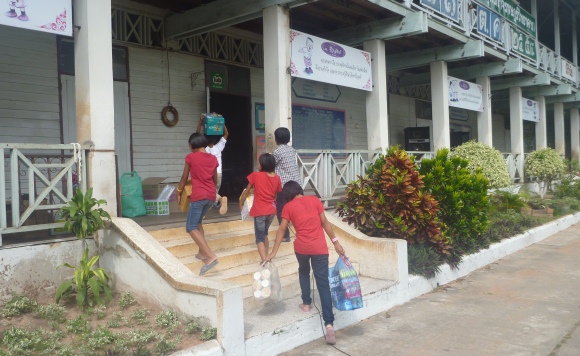 Five of our girls taking supplies into a classroom for temporary storage.
Our board member Tasanee Lapimai, a schoolteacher in Nang Rong, organized some area teachers to provide assistance for the flood victims. Our foundation participated in both donations and volunteering. With Nang Rong Community School as the drop off point supplies came in steadily for a few days, were stacked by volunteers, loaded into a large truck and taken south. My car and a pickup with additional supplies and some teenagers for unloading went along as well.
We expected to leave at 8 AM, but did not get away until after noon. The delay had something to do with drugs being transported through our area. We finally went to the police station and got them to inspect our truck so everyone could be satisfied we were not carrying drugs, except for the known drugs we had for the flood victims.
Highway 1, the main road from the North into Bangkok, was closed due to flooding. We took an alternate route to the shelter set up at Thammasat University. We wanted to take our supplies to Ayutthaya, on the west side of the river from Bangkok, but the police and military did not allow anyone to enter the flooded areas. We soon did run into that horror affecting a much wider area of Thailand, the traffic jam. That bypass of highway 1 took us two extra hours, since everyone else was taking the bypass with us.
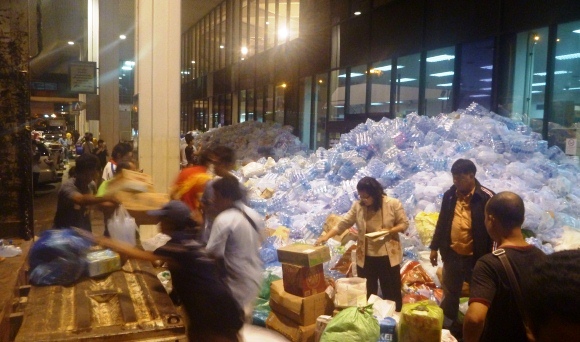 Tasanee checks off some of the more important of our supplies outside the Don Muang terminal building.
We arrived at Thammasat early in the evening. We heard there were more than 2000 people sheltered there. We saw many volunteers, but most of the others were housed in the dormitories, away from the convention center where all the goods were dropped. They could take our supplies, but already had plenty. Going further to the distribution center set up at Don Muang Airport made more sense.
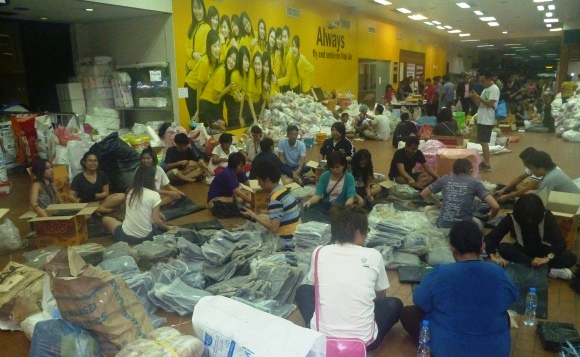 Volunteer young people repackage assistance goods in one of the downstairs terminal areas.
Don Muang was the international airport until replaced by Suvarnabhumi in 2007. It is still used for domestic flights and is a huge place. There were vast piles of bottled water and other supplies both outside and inside the terminal. School is out here now, so there were hordes of university students along with farang backpacker types throughout the terminal repackaging donated items into “care packages” which were loaded onto various military transports for delivery to the flood areas.
It was into the morning hours by the time our supplies were unloaded and we headed back, but the traffic on the bypass was much less. Nathan and I finally got to bed at 4:30 AM.
Given the scale of things at Don Muang, our donation was a drop in the bucket. Still, it’s great that so many Thai people are helping each other and was fun to be a small part of it.
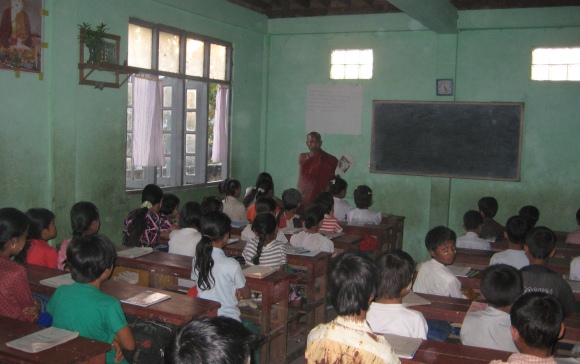 Many elementary classrooms in Myanmar are taught by monks. Sue and Gayle Holmes plan to update their teaching methods.
I just successfully purchased four round trip tickets on Air Asia from Bangkok to Yangon, Myanmar. Sue and I are going there with two Australian friends to do teacher training under Nargis Library Recovery. You may have been hearing lately how Myanmar is opening up at least a little, no thanks to continued US and EU sanctions. We are taking advantage of that and will be among the first foreigners to work with school teachers there. I’ll say more about that when we return to Thailand mid-January.
After purchasing those tickets I feel like I really accomplished something. The process turned out to be as breathtaking in scope as it was extreme in complexity. First of all, I got everyone’s names, birthdays, passport numbers &expiration dates as well as other personal information – Air Asia wants it all. They also default to charging for extra legroom seats. Uncheck that and you get the normal seats, which they still charge extra for! I finally found a button to uncheck all seat selection, which is no extra charge, but warns you that your party will not sit together. To get even for that I suppose they will put each of us in a center seat between to big guys that smell bad. They charged for each of us taking a checked bag. I unchecked two of those but found out 3 screens later that I had to uncheck it separately for the return trip.
Anyway, it went on like that until time to pay. They declined my normal credit card, so I called the card company. Fortunately calling 800 numbers from foreign countries via Skype is free. They said everything was fine, so I called Air Asia to find out that they simply do not accept credit or debit cards from the US due to their higher fees. I have seen that on a few other websites in Europe, where the drop down list of the card issuer’s country has everyone (even Afghanistan and Iraq) except the US, Myanmar and North Korea.
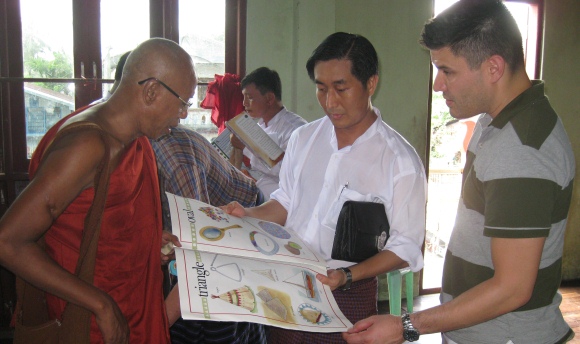 Hector Rivas of Thrift books and Thant show a monk teacher new curriculum Nargis Library Recover can supply.
Do people in the US think that the card companies supply them with kickbacks from their rewards cards for free? Either the card holder or the merchant has to pay for that. In this case the merchant, Air Asia, decided it won’t.
As much as I admire their stand, the only alternative I had to using a card was getting to their office Suvarnabhumi airport which means going an hour outside of Bangkok. So I tried my Bangkok Bank card.
This was the first time I tried using my Thai card on the internet. I use it here because it has none of the rather stiff fees (some originating from the US) that the foreign debit and credit cards now have in Thailand. What an experience! It included phone calls to automated systems where I entered account, code, pin and other numbers, entering codes returned via SMS, other codes returned via my email account, thinking up my own 8 digit codes and writing them down and entering them twice, etc. I got timed out of the system several times, but of course each time I was that much faster when I came back. I learned a lot that was not worth learning.
It finally worked, but the codes produced by all this are good only for eight days, so next time I’ll have to do it all again! I’ll forget everything I learned in this process by then.
I wish I could use my US card. Of course there are some US credit cards that are not rewards cards, but the merchant can’t tell which those are. I know, because we process credit card donations on our foundation website, and cannot tell what the charge for an individual card will be until after the transaction is done.
Maybe the card companies will have to change. The world economy is changing. Airlines especially are looking to charge an extra fee or save a buck wherever they can. Those where US business is a small minority may just choose to get rid of it altogether, like Air Asia did.
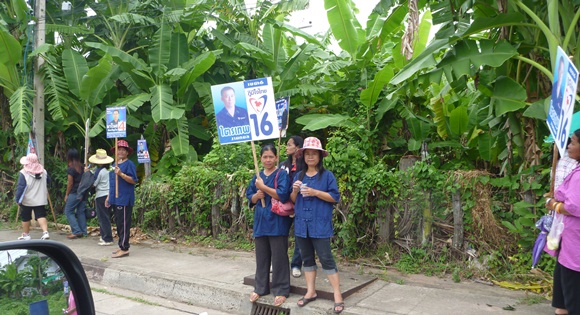 It’s election time in Nang Rong
I just wrote about our first four wheeled vehicle. A CNN news article today said there are now 800 million vehicles on the road and by mid century that could go to between 2 and 4 billion. The claim is that we are approaching gridlock in many parts of the world. It was written by someone from Ford Motor Company so I assume they meant four wheeled vehicles, because in this part of the world there are a whole lot more two wheeled vehicles.
This is not news to me, since we are just about to gridlock here in Nang Rong. At least half of the time I have been out in my four wheeled vehicle lately I have had to pull over and wait, maybe even back up a bit, or cause the other people to do the same. Yesterday I just had to stop in the middle of the street until people parked some ways out from the curb on both sides of the narrow street finally moved.
Nang Rong was built before there were motorcars, and Thailand has taken a great deal longer to acquire a significant number of cars than the US. Especially up here in Nang Rong. Well, we have them now. The streets are narrow, buildings built to within a few feet of them, leaving a narrow sidewalk which is usually loaded with shop goods so everyone walks in the street. View at corners is blocked by buildings so the average cornering speed, even off the main highway into Nang Rong, is about 2 miles an hour with your car coming within inches of the cars waiting at the light to go the other way.
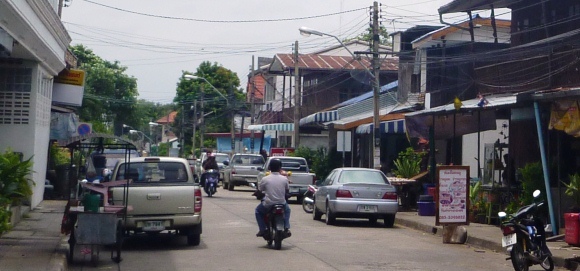 Not the most narrow street in Nang Rong, certainly not the busiest, just the street in front of my house. My driveway is on the right just past the green stripped awning. One way traffic works here. It is a two way street, for motorbikes anyway.
Cars are relatively new here. Many even older people have just recently learned to drive them. They are not reckless or dangerous, you have to be young to be that, and most of the young people still don’t have that kind of money here. Their elders are very slow and careful. They may not yet have learned where the car is and so may park half a car’s width or more from the curb, which makes streets hard to navigate when the person on the other side parks that way also. Add traffic coming the other way and now it is impossible.
Some informal Thai rules of the road:
• Do not go the wrong way on a one way street unless it is for a short distance. Of course if you are a motorcycle one way does not apply.
• If motorcycles are parked at the curb you may park away from the curb outside of them.
• When you stop at one of the three lights in town leave space in front. If you don’t the motorbikes will go around you anyway, and those that don’t fit in front will get stuck beside you, making it that much harder for you to get going without knocking into them (narrow streets, remember?).
• Always use your turn signals when ready to turn. The motorbikes are going to pass you anyway, but you can influence on which side.
• Always watch out for motorbikes. Remember the “reckless and dangerous” young people I referred to above? Well guess what they drive.
• If you get a phone call while driving on the highway your natural Thai caution has you slow down to a few miles an hour – on a blind corner with possible high speed traffic just out of sight.
• When doing road maintenance on any road, even a major highway it’s OK to have an abrupt 6 inch change in level with no warning. Going down these is really not too bad, but going up them…
• Don’t EVER ride a motorbike fast at night (see above).
• If you need to do something really unusual or crazy, just turn on your flashers and everyone will understand.
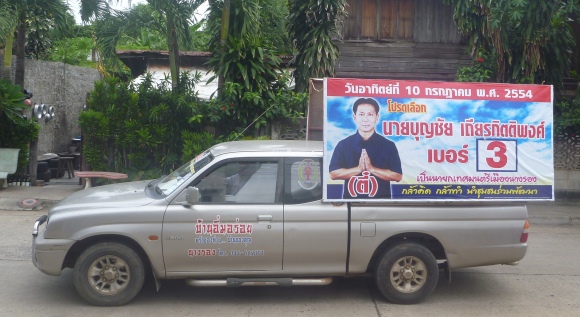 Taken out of my driveway. He starts coming by at 7:30 AM. Do you suppose he bothers someone else even earlier?
This leads me to the next traffic problem: elections. Fortunately they only have them every four years. For a town of this size there are an unbelievable number of speaker trucks driving around town very slowly while making the most noise possible. They start on my street at about 7:30 AM every morning. The worst offender is candidate #3 (out of about 16). The announcer, with great excitement, yells his name several times in a row and then goes on to tell of his greatness in such an excited tone that it quickly leads to emotional overload and exhaustion. He comes by a number of times each day. Multiply that by 16 or more candidates and you begin to understand. Each candidate may have many trucks. They are all over and moving slow. At one point I saw six of them in a row, for different candidates, all with speakers going full. Whether a Thai could understand any of that I don’t know. I surely could not.
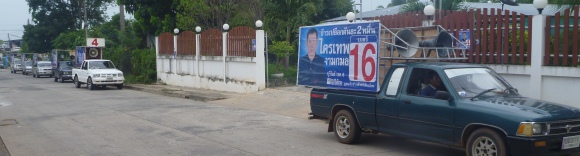 Six sound trucks, different candidates, all going full blast.
So, is it safe to drive here? I would say yes, it is overall. Certainly a lot safer than some other countries with which I am familiar, like India. if you try to keep to the daylight hours, and avoid holiday evenings when more people are drunk. I know more people here recently involved in accidents than I do in the US. The rate of severe injury and death from accidents is not so bad, because driving here is slower. Some things are safer. Riding a motorbike in town here is much safer than doing that the same in town in the US. The town is built close together, streets are narrow, you go so much slower, especially when there are lots of sound trucks. Actually, for motorcycle accidents, I know more people in the US…
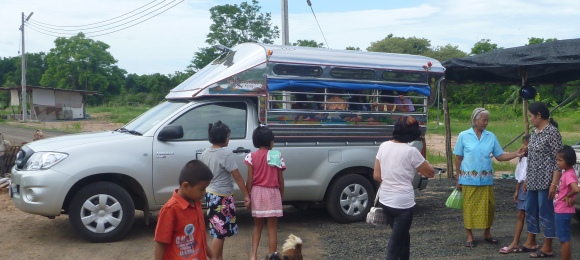 Our first four wheeled vehicle!
We bought our first truck. Up to now the foundation owned two motorbikes for staff transportation. When a larger vehicle was needed it would borrow my or Walai’s car. That will still occur in some cases, but now we have a pickup truck with a song taew back on it. So we can haul 20 kids or take off the back and use it to haul whatever pickups are good for. We saved money by not getting a four door or extended cab model, and the bed of these simple pickups is longer, allowing song taew space for more children. The truck has daily use getting our kids to school and now we can take group trips more easily.
There is an earlier post about our foundation’s use of song taews.
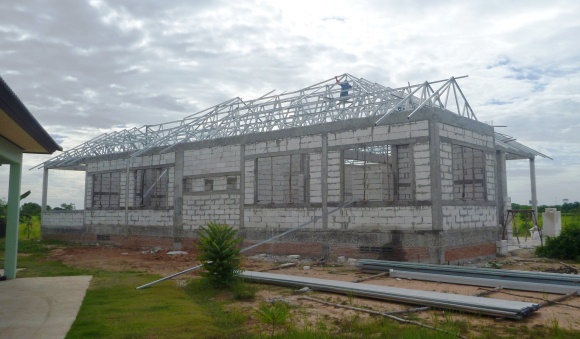 House #2 under construction. Can you spot the wide pillar along its wall?
We are building two new houses, one on each side of our first. The one on the right (#2) is further along than #3, but we hope both are complete by November. One thing a little unusual for this area are the wide concrete posts at strategic locations. Their purpose is to prevent an earthquake side thrust along each of the concrete ceiling beams from collapsing the structure. Side thrusts across a beam are taken up by the beams that intersect them. These have their own wide posts attached. We don’t need quite the protection we would if there was a second concrete floor above, but there are the concrete beams and a tile roof.
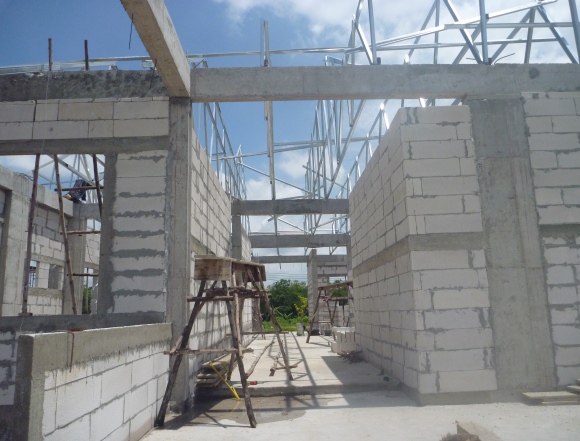 Note wide pillar in the wall in right foreground. Also one along the wall at the left edge of the picture and one going crossways a little to the right, under the ceiling beam .
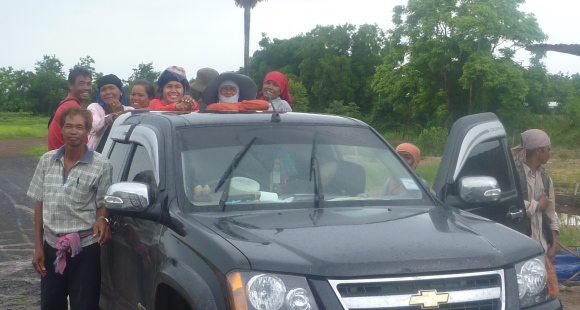 Construction workers leaving at the end of the day .
The two new houses will be nearly identical to our existing one. The next two houses after these will be smaller, each designed for a maximum of eight children. The smaller homes are less expensive. We need both for different situations and will be evaluating what works better as time goes on.
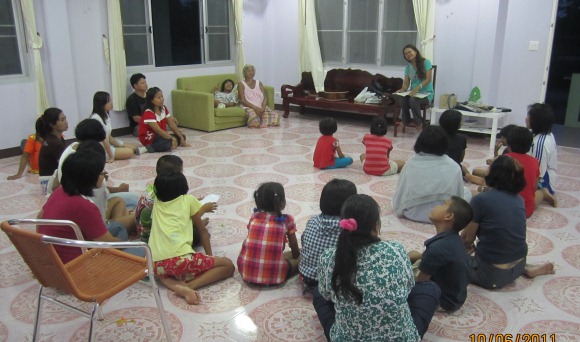 The girls and elderly meet in our new home’s main room.
I came back to Nang Rong for just the month of June to finish up various things. I was surprised at the weather this time. April and May are normally the hot months, and I’m told that May was pretty hot this time. There were a couple of hot days when I first got here, and then it settled into breezier cooler weather. I starts to get hot, then it rains for 20 minutes and really cools thing off. The cool weather often lasts into the next day after which the cycle starts again. It’s often overcast. Back in Idaho that was usually gloomy and cold. Here it is an entirely different feeling. There it’s cold and the wind bites. Here the normal light wind makes it just right, much better than I anticipated.
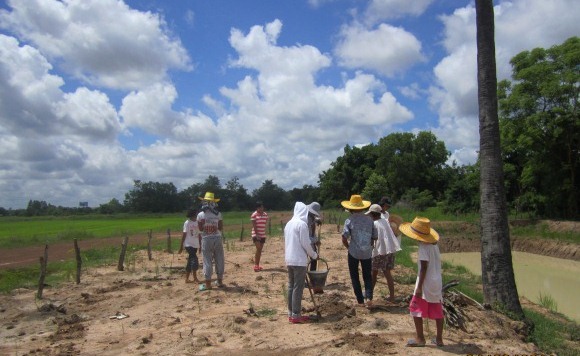 Planting corn by the fish pond.
Things go well at the foundation. We have a couple of new girls with three more coming soon. One more elderly lady has come since I left last time. I show a meeting we had a few days ago, and some of our older girls out planting corn by the newly stocked small fish pond. Some local villagers experienced in farming and fish raising are advising us on this.
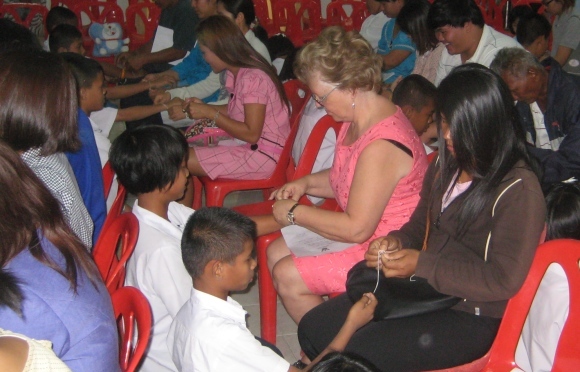 Sue ties the string around Bhu’s wrist, giving her blessing.
A month has gone by since the last post. Too many things to do here. Yesterday we brought in a narrow scoop backhoe to dig the water supply trench. Just short of 500 meters total. I could not watch them start because I was busy that morning at a graduation. One of our girls graduated from sixth grade yesterday. Another graduated this morning and we were there also. I have just a little time now before we go out to the village to meet with a volunteer group of teachers from Singapore at 4 PM.
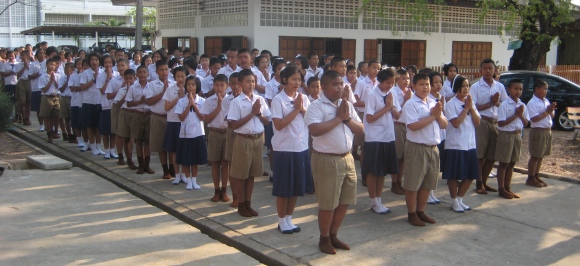 6th grade graduates just before marching into the building.
We got there a little before 8 AM for Bhu’s graduation so she could show us where to sit. Ceremonies started at 8 with the school Thai band playing. There were four speeches from dignitaries of decreasing importance. It seemed like the last guy, who was least well dressed and had by far the shortest speech was the only one really listened to. I think he was a teacher they liked. The sixth grade Thai dancers performed after which the students received their degrees.
At one point the students all came and kneeled before their mother or father to show respect and had a string tied on their wrist signifying the parent’s blessing to the student. Bhu’s mother was unable to come so Sue took her place, as shown in the picture above.
We did not get breakfast and the proceedings lasted almost 4 hours. We were grateful to some of the foundation staff who also came and provided a few snacks. Otherwise I think that last hour of Buddhist chanting would have done Sue in.
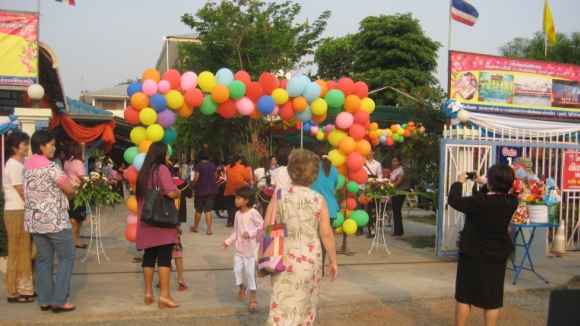 Sue entering the school for Mai’s kindergarten graduation.
This morning it was Mai’s turn to graduate from kindergarten. Thai schools have graduations at kindergarten, 6th and 12th grades. This time there were no long speeches and no chanting. The kindergartners, 4th and 6th grade dancers performed.
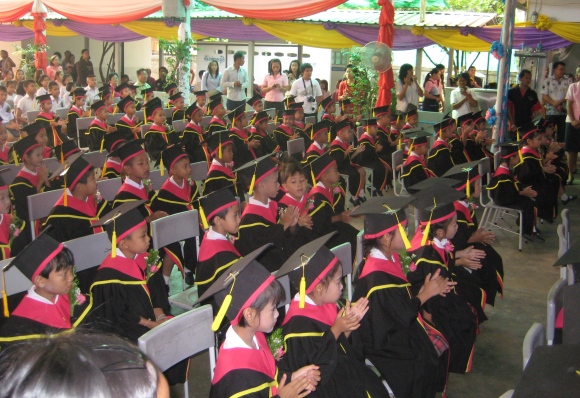 Mai’s class. She’s in this picture.
We are leaving Nang Rong on the 18th or 19th of this month. There are still a number of materials to buy for the new houses, I need to do something about grab bars in the bathrooms for the elderly ladies coming in, check on water main sizes, the contract for the third house is signed next week, meetings… Regardless of all the things to do, we still would like to stay longer. We always want to stay here longer. Well, it will be getting hot for a few months.



