Today I noticed a CNN.COM article titled “7 Myths about Traveling in Thailand”. I agree with everything in it. Myth number 3 was titled “Everyone is out to scam you”. It explained that some were, but many were not and “This is particularly true in less-traveled regions like Isaan, in Thailand’s notheast”. That’s where we are located. So do see Bangkok, but don’t forget to visit our area also.
I also liked the last Myth titled “By giving money to street kids, you are helping them.” It explained that you are not helping them, just as I have already explained on our foundation website.
“Always acknowledge a fault. This will throw those in authority off their guard and give you an opportunity to commit more.” – Mark Twain.
This is the third in a series. The first two posts concerned our child raising efforts in Thailand.
NGO’s often hide some kinds of problems if possible. Certainly not the problems they address in the world. They want you to know all about those so you will donate to help eliminate them. Internal problems are different. Suppose an employee embezzles a significant amount, or maybe a scandal of some sort. Who wants to donate to an organization just to have your money wind up in someone’s personal pocket or support something much worse? Being honest about these can be a disaster and hurt the reputation of the organization long term. Often their hold over the donors is not very strong to begin with. There are no shortages of places to put your money or nice appearing organizations claiming to put it to the best use. Even though you are working all out to fix the problem, if word gets out a lot of support can evaporate. In looking into this subject I find that in general, NGO’s indeed often do hide issues of this sort. It’s a survival issue and they feel they have no choice.

 This children’s library is well supplied, although we so far had not given any books here. We found out later only people like us see it. The kids apparently don’t have access. Well, it was nice and neat.
Problems will occur, however, if what you’re doing is at all different from what is already being done or if you are doing it in a new place. One problem that I think is present more than any of us would like is that of simply not being effective. You’re doing something and it looks good, but in the end it does not result in anything useful.
This year’s Nargis Library trip to Myanmar was a success in many ways, not the least of which were our workshops. There was one problem, however, and I’ll take the risk and tell you about it. We determined a number of libraries to which we gave children’s books have kept them in locked rooms or on locked shelves. The books are not getting to the kids. About the only use they do have in this case is to show off to visiting dignitaries, like us, or George Soros, who we heard visited one such library at a school a day or two after we did. That library was a very nice one, which while small had nice shelves and small sized colorful furniture for children. In this case we had not given any books to the library, and will not unless things change.
Looking at the people involved, it is not too hard to see how this happens. On one side we have librarians whose directive is often “protect the books” or at a few larger schools where for administrators it is “show a nice facility to impress donors”. There may be some cases where lost or damaged books are deducted from a librarians pay. When you make $60 a month that can hurt.
On the other side we have somewhat grubby village or small town six year old child living without any plumbing. Who is going to “protect the books”? How will the children’s library impress potential donors if its get extensive use from children like this?
 Kids in Myanmar really go for these books. Many have never seen the like before. (Photo Thant Thaw)
Each book is pretty, colorful and in good condition when the Burmese get it. A valuable item, but they see its value differently than we do. We want children to have as much access to the books as they can use. We want them to learn from the books at home and at school. Their value is different to us. We get them free in the US from Thriftbooks and ship them over one 40 foot container at a time. We pay little or nothing to distribute them to the places that don’t have such things through the monks, World Vision and others. We are trying to convince libraries to let the books wear out from use. We’ll replace them.
Sue has already been through this in the Indian slum school she has. Its library has books we brought over in a container a few years back. It was a difficult process to keep the book shelves from being locked up. The teachers just had to protect the books. It has been an amazingly difficult process to make the teachers there allow the children free access to the books. Can we convince the librarians in Myanmar with whom we do not have as much control? None of us are sure right now, and the school administrators could be even more difficult. We’re working on it. We are also developing our follow up methods. How do you think we figured out what we know now?
We are thinking about plan B. As we do more workshops we have three days to convince teachers to teach completely new ways using common children’s books like “Rosie’s Walk” or “Dear Zoo”. It’s pretty clear that they are getting the idea and are changing. We’ve already met some teachers a few days after the workshops and got glowing descriptions of their use of our methods in their classrooms. Hopefully our follow up next year will confirm all of this. While we have this captive audience why not also enlist them to get our books into the hands of the children as well? They are definitely changing in one area. We are pretty sure they can change in this one also.
 The purpose of Nargis Library Recovery.
Our Third Workshop
 A young monk elementry teacher acts out the story for the other participants. Gayle sits on the floor to the left. (Picture from Thant Thaw)
Our third workshop was held at the Phaung Daw Oo Monastic High School in Mandalay. Here nearly 6000 students receive education completely free of cost, courtesy of a number of donors both within and outside of Myanmar.Ven U Nayaka is the principal. The workshop went very well in a large room at the top of a classroom building. The school area was in some ways like a small town, a village enclosed by a wall with dormitories for students and teachers.
Soccer playoffs for both students and teachers were happening outside the building. These went on the entire time we were there, even during the rain on our first day. I guess for this size school it takes awhile to run through all the teams.
 Soccer playoffs from the third floor balcony outside our classroom.
The students included two monks. I may be wrong in what I said a few posts ago regarding monks touching women. Here I saw that happen a little, like in a handshake between Gayle and a monk in the course. It appears that monk elementary teachers will be coming to our workshops along with the other teachers.
John Badgley and Thant Thaw Kaung, directors for Nargis Library, were both present along with some other INGO people to observe, and along with every student asked, all agree that we have to find a way to continue these workshops. Nargis Library can now add a new purpose, beyond just importing and distributing books and publishing Burmese school books here. It will certainly fit in well with what we already do.
John will be checking with the US State department to try to expand our US Treasury Department exception, now limited by US sanctions, to deal with the government education departments in Myanmar. Thant will be checking with those departments here. We have to get Gayle freed up from some of her teaching duties in Australia. We also need to set up a follow up program to make sure all these good impressions we have now have some staying power. There is a lot to do.
December 30th, 2011
admin
 From Mandalay Workshop. People say what they think here, even criticize the government. No one appears worried about who is listening. (Photo from Thant Thaw)
Things are changing in Myanmar. Perceptions outside are changing as well. This time when we got our visas in Bangkok the lines in the street were three times what they were last year. Processing was faster as well. Once they opened those lines disappeared in less than a half an hour. Tourism should be way up compared to last year. Even so, it will still be just a few percent of Thailand.
Myanmar is still a mysterious country to most Americans. I’ve seen news stories about corrupt or “non democratic” countries that class Myanmar in with North Korea, Syria and other such countries. For example, on Christmas eve in my hotel room in Myanmar I saw on CNN news, available with no censorship I could notice, the text running across the screen bottom: ”Pope prays for Syria and Myanmar.”
Myanmar simply is not comparable with these countries. In North Korea I’m sure I would never get out of sight of some tour guide handler working for the government and there would be only certain places I would be allowed to go and see. In Syria I’d probably get shot by one side or the other. Here we can go where we want and look at what we want. If we are under surveillance they certainly are good at hiding it from us. Sue and I were with a group in Egypt a few months back where extensive security precautions were taken for us. I felt they were needed. Here we walk by ourselves large cities at night when the power is off (which can be often) and feel perfectly safe. In one city we were on our own and heard children in a school . We went over and looked in the door and were immediately invited in. In the U.S. we would have to get permission from the office and probably be assigned an escort.
In previous years I have warned everyone that we would be out of contact during our time in Myanmar. Right now I’m sitting in a very nice hotel in Yangon, hooked to wireless internet. I have already posted three blog articles although access is now slowing so I may need to get the rest of this off in Thailand. I’ve perused cnn.com and sent out a bunch of emails. There is no government censorship of the internet that I have heard of or can detect myself. The hotel desk clerk did recommend I not use the internet on Saturday and Sunday. They said all the young people will hit the coffee shops, cafes and other public places and use the free wireless. Throughout the country the internet will slow to a crawl since the infrastructure is not so good yet.
I have heard much more in various discussions and conclude with many people here that freedom in various areas is coming faster than anyone has expected. I am not a Burma expert and will not go into the details, but you can look up Derek Tonkin or Robert Taylor on the internet and see what they say. I have been with each of these people and feel they are among the most informed and reasonable sources about Myanmar and its current condition.
I see pictures of opposition political people hanging on the outside of some homes, among them Aung San Suu Kyi. She is even running for parliament now. She is a wonderful lady and has suffered much in the past. Still, it has been counterproductive that the US has for more than 20 years treated her as the head of state here. It would be like the EU deciding that the 2000 elections in the US were unfair and treating Al Gore as head of state for the next 20 years. Treating Suu Kyi that way might be nice, fair and maybe even just in some way, but it has not been useful.
The government here has loosened things up. They still have a long way to go and a great many things to fix in how they operate. Just recently Hillary Clinton came for a visit and talks, but the U.S. policy toward Myanmar also has a long way to go and many things to fix. It will be interesting to see who goes faster, but at the moment it appears to be Myanmar.
December 27th, 2011
admin
 It’s easier to tell some stories than others. (Picture Thant Thaw)
On the last day of the Yangon workshop Keith was a bit under the weather and did not come. We had boxes of children’s books from Nargis Library to distribute to our participants. The novices had returned from school a little early and had quietly entered the back of the classroom, discovering the books. They were quite excited as they looked over the books but remained well behaved. Even so, they could not help making a little noise as they shuffled things around. Like most rooms in Myanmar, there are only hard surfaces on the floors, walls and ceiling, so any sound carries. Most of our translators were girls whose voices were not as loud as those of the boys in Bogalay. Soon Sue came back and told me to clear everyone out.
I picked up an armload of books and indicated to my friends to do the same and we all walked to an open air classroom across the courtyard. They get some instruction in English, so that the older girls were soon doing some reading in the books on their own. The younger ones gathered around me.
 We can’t keep them completely quiet: the girls come in after their school is out and discover the Nargis Library children’s books.
I found that some of the children’s books worked a lot better for this particular audience. The context of some had no analogue here and others have illustration styles that did not seem to connect. Plenty were good, however. Books that are very popular in the US seem to go over well here also. Mercer Mayer, Maurice Sendak, Richard Scary, and some of the Disney books. I had the best time with “Five Monkeys” (jumping on the bed, one fell off and bumped his head). And “Something Funny” in the “Read with Dick and Jane” series, the same book I remember from first grade. These had the right amount of repetition for the little ones. I had no problem holding the their interest with these.
 Older girls reading books from Nargis Library
December 26th, 2011
admin
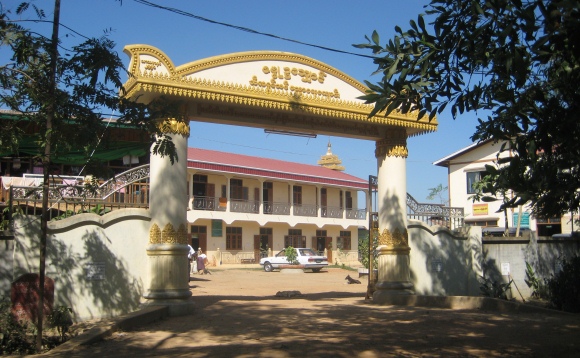 Zabu Oak Shaung Convent School in Kyauktan outside of Yangon
Zabu Oak Shaung Convent School is a 45 minute drive outside of Yangon. It has received some of our books through a community library in the area. Most of the nuns living at this school are 150 novices between 4 and 14 years of age. They also go to school there. There are about 350 outside students, 100 of them nuns from other convents, in the school as well. Parents in the area have been switching their children from the government schools because the education is so good. The Head nun here is Sayalay Daw Wimalasaryi and it’s obvious that she treats her girls really well.
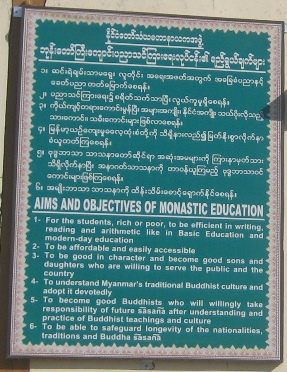
School guidelines are on several buildings
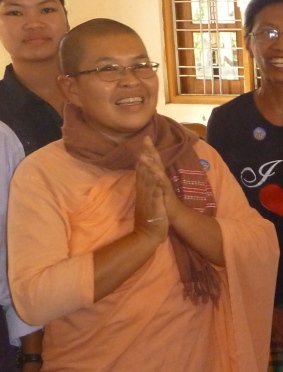
Head nun Sayalay Daw Wimalasaryi
About 100 of the 150 girls have no close relatives and so by many standards are “true orphans”. Daw Wimalasaryi does not adopt them out. She feels most prospective parents would want to use them for work or supporting their families in other ways. Adoption in this part of the world does not seem as desirable as in the US, where couples are desperate to adopt children, waiting a long time and spending huge sums. One person in Thailand confided that the return rate for children was too high. Parents might adopt and then get pregnant and have their own child and return their adopted one.
As much as parents now love their adopted children in the US, before 1900 there were many orphanages with unwanted children there. How many stories are thereabout “orphan trains” that took children west in the US, where many would be adopted with an eye to their ability to help on the farm? How about some of Dickens’ stories illustrating children starving in the streets, or in the workhouses of Victorian England? Weren’t these societies more “Christian” than we are now?
I think the main reason we adopt the way we do now in the US is we have more wealth. Leisure time and the concept of “happy childhood” is available to most of our families. We can think about getting and “enjoying” a child. A new child, especially a baby or very young one, is so cute, the probability of it dying soon from some disease is nothing like it used to be and one more mouth to feed is easy for us.
 They’re not caged. Wire is used instead of glass in many buildings here, in this case for their dining hall. Most of these are true orphans, but you can’t adopt one.
I need to get a video of a line of nuns, all with their parasols, from the tallest back to the shortest novice snaking through the street to places on either side where they receive food and alms. It’s really something to see. I don’t see many white robed nuns Thailand, but I see pink robed nuns and novices everywhere here. When I asked why I was told it is economics. Back in the middle ages monasteries were a mainstay in the culture and provided a place for travelers to stay, just like now in Myanmar. I think the poor economy here creates many parallels with the past in the west when we in the US and Europe were much poorer also. Coming to Myanmar and some parts of India are as close as I get to the feeling I have when I remember going as a child with my grandfather to some places in his small community.
 Nuns and novices collecting alms
If we at Opportunity Foundation in Thailand had our girls out begging for support in the town we would quickly get in trouble with everyone. As I noted in a recent post , using orphanage children for any kind of work to support the their institution, certainly for begging, is really looked down on in the international NGO community. Things are different here in a Buddhist culture. It is traditional for Buddhist monks and nuns to beg for food and alms in Thailand and Myanmar where they are highly respected. The day I took the video of the novices just before lunch a young couple had the honor of supplying their food. The pretty young wife in her yellow dress worked along with the older novices serving at the tables while her husband was up at the front table with the head nun.
 Head nun Sayalay Daw Wimalasaryi and novices
The girls can leave the school any time after they are 18 or can remain and be a nun for as long as they wish. Many orphanages in the early US and in Europe put the girls out on the street when they were 18, leaving them few options beyond prostitution to support themselves. Many in Eastern Europe still do.
December 24th, 2011
admin
 Class photo for second workshop outside of Yangon
Yesterday was the last day for our three day Yangon workshop. Sue expressed some concern after the first day. The participants were different, more sophisticated than those in Bogalay. Most spoke passable English so that translation was sometimes needed and sometimes not. There was some confusion about the time of the workshop and a few had to leave early. All this was corrected by the second day and now Gayle, Sue, John and Thant all agree it was very effective and a great success.
 Classroom scene from second workshop
We held it at the Zabu Oak Shaung Convent School about 45 minutes out of Yangon. Thant found out about it through a library we supply in that area. Being close to Yangon and its international schools we had a lot of volunteer assistance from three students as well as Thant’s ninth grade daughter and two of her friends. All spoke good English. Since most of the translation is from English into their mother tongue it went very well, just as it did in Bogalay.
With all that help Keith and I were not needed in the classroom. Keith just sat outside on a bench to relax. He’s a big guy and his beard can be a little scary at first to kids in a country where men usually don’t get hair on their chin. Kids really like Keith, however, and after a few minutes he was surrounded. It’s no different than our Indian slum schools where Keith is like the Pied Piper.
 Keith and the girls outside our classroom
The head nun Daw Wimalasaryi and a number of her teachers participated on our workshop as well as some other teachers from surrounding government and private schools. The English level of our teachers was unexpected. These were just general elementary school teachers , but they understood most of what was said before translation. This was not at all the case in Bogalay.
The headmaster of the local government school stopped by and was very excited about our program, asking if we could not return soon and hold more workshops. We have had a lot of interest from various people at different levels of the educational establishment here. We’ll have to think of how to proceed from here. Everyone we have encountered here is very receptive. We are planning to follow up next year to see if we are really having the effect we want.
Classroom scene from second workshop
December 22nd, 2011
admin
 Freight hauling in Bogalay
While we had some running around for supplies and other things to assist in the workshop, Keith and I had some time to wander around in Bogalay also. The first thing we noticed as we hit the streets is that almost all transportation is walking, bicycle or bicycle taxi. Next would be motorbikes. Normally you can see one or two if you look on down the street. No one seems to haul freight with them like they do in Thailand. There were no horses or other animals pulling carts or doing anything else. During our three day stay I saw a couple of vans, five or six trucks and the same number of buses. I think the buses are for transportation to neighboring cities, not within the city. Most heavy freight was handled in large three wheeled carts pushed by two or more men. Light cargo was carried by the bicycle taxis. I saw one car.
 Coffee shop across from the library
 Temple just off the road between our hotel and the library
I passed the Buddhist temple on the way from our hotel to the workshop library several times before I turned in to have a look. It had some pretty good sized Buddha statues. The ones I’ve seen in Myanmar are usually larger than the statues in Thailand.
 Ford Fairlane oiler truck on the walkway to the temple
There was a waterfront with markets, piers and many boats. People were all friendly and polite. Most knew no English and I know no Burmese at all, so communication was arm waving and finger pointing. The waterfront street and buildings on it’s other side were most pleasant. A nice place for a walk. I’ve seen other westerners in this city before, but none on this trip.
 Afternoon on the waterfront street
Restaurants had few allowances for westerners or other tourists because they don’t have any, except for an NGO worker here and there. The only way we were served chicken was cut up with bones and all. It was difficult to tell what part of the chicken it was and sometimes harder than I’m used to to get the meat off the bone. It’s hard with a knife and fork (you do get a knife here, unlike Thailand) and the part of the bone you’d use to pick it up is not there. I should have payed more attention to how the Burmese do it. They must have a method… Overall the food was OK, but don’t come here for a dining experience.
We had air con and a flat screen HDMI TV in our hotel room. We did have cold showers and they don’t use sheets. We slept between blankets. Altogether we were pretty happy with it except the water was pretty cold in the shower. I must not be as tough as I thought. No internet or Wi-Fi at the hotel. I’m not sure it’s available anywhere else in Bogalay. Even so our hotel was the best in town because there was a new Toyota SUV parked there with “UNOPS” on its side. It was easily the nicest vehicle in town. UN people fly first class and stay at the very best places. Unlike nearly everywhere else in the world, in Myanmar we can afford to stay in the best places also, even in Yangon. We see more UN and other government related people here than anywhere else we travel.
 We get around
The beach area was covered in litter. There was also a lot of litter on the ground outside the Buddhist temple also. We westerners are sensitized to litter now, but I wonder if the locals here even notice it. While litter covered some areas, it seems to me that a small group of people could clean up the whole town in a week or so. There are no tourists down in this part of Myanmar. I think if they will need to do some litter cleanup if they want to have many. And don’t forget the hot showers.
December 21st, 2011
admin
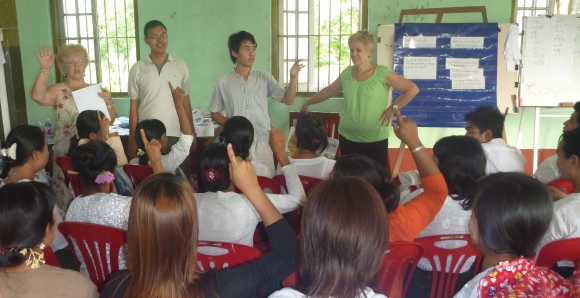 Our first workshop in Bogalay
We are in the Inya Lake hotel in Yangon, having just returned from our first three day teacher training workshop in Bogalay sponsored by Nargis Library Recovery. Everyone agrees that it went really well. Gayle Holmes taught with Sue assisting. We met Keith and Gayle in Bangkok a few years ago. Gayle is a master teacher from Australia and has been training teachers in Sue’s Indian slum schools for the last few years. Keith is an extremely practical person who can fix or build anything. He has lived many years with aborigines in the most violent place on earth outside of a war zone. He has also lived for a time “off the grid”, using no money, growing, building or trading for everything he and Gayle needed. I’m hoping for his advice and help as we develop Opportunity Village in Thailand.
Two student volunteers from international schools in Yangon, Htet Thiha Zaw and Thaw Phone Myat, went with us to translate and help with logistics. They were great. All the teachers understood everything and got a lot out of out first workshop. It’s good to know we will not be needing any professional translators.
 The Bogalay Library
The workshop was at a library a ten minute walk down the same street as our hotel. Nargis Library has previously supplied books to this library on several occasions. We had the entire second floor which was great for 25 teachers planned to be in the workshop. We ended up with 35, so it was a bit tight but worked out OK.
I had thought we would have some monks, who teach elementary students in the temple schools, but instead a number of “laymen” lady teachers who also teach in the temple schools came. Once the workshop started I could see why. Buddhist monks cannot touch women. They can’t even touch anything a woman is also touching. Nearly all the other teachers in Myanmar are women, and it would have been impossible to avoid inappropriate contact during the various workshop activities. Teachers working in World Vision and public schools came In addition to the monastery teachers.
 No way can you buy materials when you make $50 per month. Our teachers learn to make them from materials we provide
Since Nargis Library is sponsoring the workshop, it was appropriate that the basic thing being taught was how to read a book and get everything it has to offer. Using children’s books with pictures and a few words per page Gayle showed activities to stimulate thinking in both smarter and less capable students, and make learning hands on and interactive. Children’s books were the basis for literacy games, dramas, crafts and discussions aimed at making students think about the book . . . and beyond the book. Participants were excited that could be so much fun. The story characters, good and bad, were related to people a child encounters in real life.
Activities included making puppets of the book characters, re-writing the ending of a book, and teachers contructing from scratch a book to be used in their classroom. These were repeated using different story books, so that teachers could practice skills useful with any children’s book avaliable in the library.
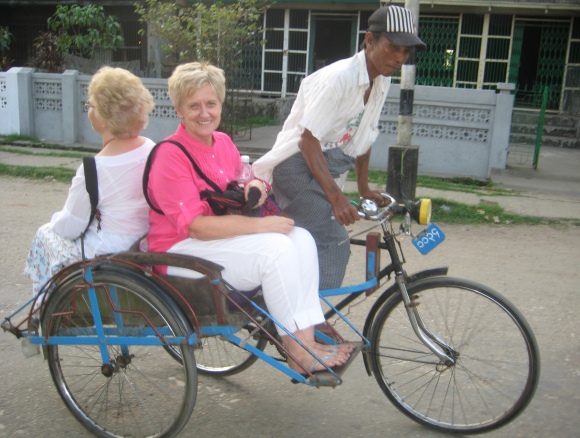 Returning to our hotel after a hard day’s work
Like a lot of important knowledge, much of what Gayle teaches seems pretty obvious once you think about it. Still, it is very different from the teaching methods used here now, but you could see the lights go on in the teachers as they listened and participated. They were really getting it.
 With all our worldly goods on a bicycle, we’re ready at the pier to leave Bogalay
December 20th, 2011
admin
 Keith and Gayle on our River Boat
This is our fourth trip to Bogalay but Gayle and Keith’s first. We’ve always gone by road before, which has been pretty interesting judging from the number of pictures I have taken along the way. The trip does take a number of hours on Myanmar’s “hand made roads” however. This time we took a river boat, which turned out great. Sue and I agree that this is the way to go from now on.
 Corrugated metal turning brown and wood turning silver with age blend together in many towns along the way
Our boat was a very long and the width of a 737 jet. Like a 737 seating was six across on seats made for rear seating in a van or SUV. We were in the first class section in the front, just behind the driver’s cabin. Our area had windows and an air conditioner, although the windows were open and temperatures very comfortable at this time of year. The much longer rear section was open air, with shades for hotter times. They left the sliding doors from the outside to our cabin open so we sat by them some of the time. At other times we went to the back and stood at the rail.
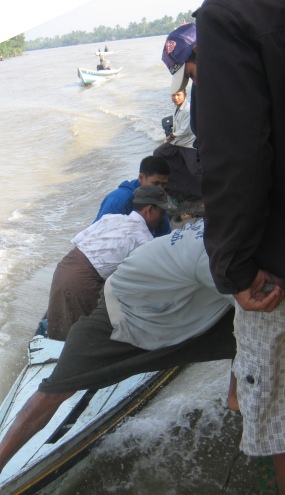
Coming in for Passenger Transfer
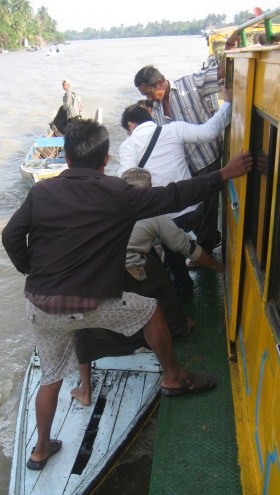
Passenger Transfer
 Walking the plank
We got on and off at a dock, but many passengers did this on the fly. More got off along the way as we headed out from Yangon and more boarded as we returned. Whether walking the plank at a dock or stepping from a pitching small boat to a full speed ahead river ferry, the ladies did it all in their long skirts. It reminded me of Ginger Rodgers doing everything Fred Astaire did, only backwards in high heels.
 Our boat leaving to go further beyond Bogalay



