February 19th, 2010
admin
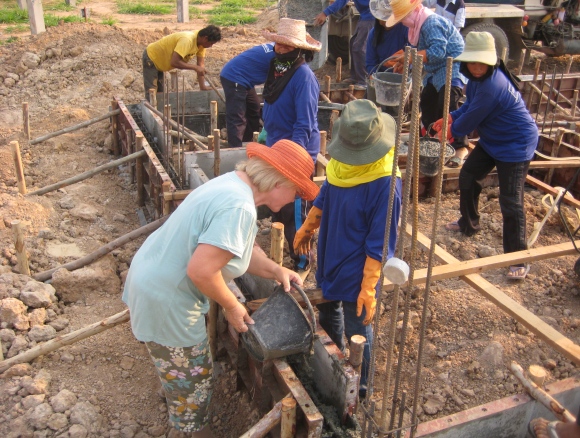
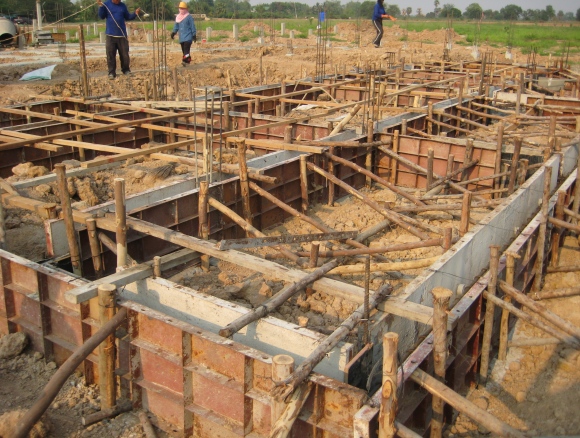
The forms were completed, rebar inspected and we started pouring foundation concrete the same day we were planting the first large trees. Sue was helping out in both areas, although she spent a lot more time on the tree project. Landscaping and gardening are things she really likes. The second picture gives a better overview of the low beams which will support the driveway to the side of the house. The higher beams for the house itself have not been formed up yet.
February 18th, 2010
admin
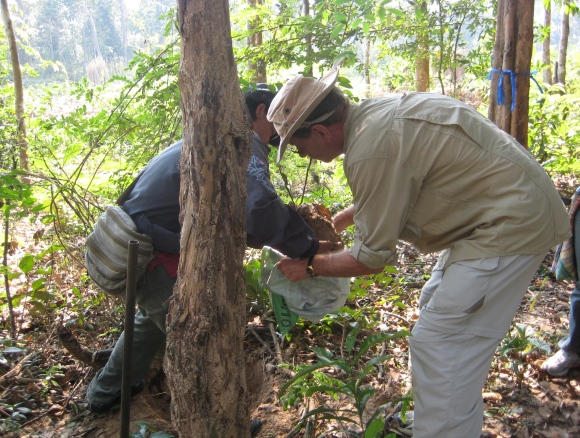 Ho and I put a bag around the roots of a small tree in the forest.
Sue and I just got back from a short 35 km trip east to see Thai forest land. We went with Uan, a Thai friend, and Ho, one of our fathers. When we got there we picked up Uan’s mother and went a few more km to the house of some of their friends. Uan’s mother grew up in the forests and knows a great deal about the trees there.
They were clearing their forest land to grow sugar cane. Uan explained that the old Thai forests may well be gone from the area in the future. At some trouble and expense they were delaying so that Uan could come in and dig up some of the larger trees for replanting on our foundation property. A large tree prepared for planting can cost a lot. We are getting them free, just paying some for labor and gas. The last load of seven trees (installed) cost us a fraction of what one tree would normally cost.
It’s dig up trees in the morning; transport and plant in the late afternoon. Ho was up past eleven at night watering the first load to get them initially settled in.
Most of these people are sad at having to do this. They grew up in the forests and would love to keep them. Their economic situation tells them otherwise. The land is an asset that they must use if they are to educate their children and have a normal life in modern Thailand. Some have taken to growing pineapple, which can be done under the trees with little forest clearing, but the cane gives a much better return.
In the future it may be that our foundation property will be one of the few places left in our area where some of these trees still grow.
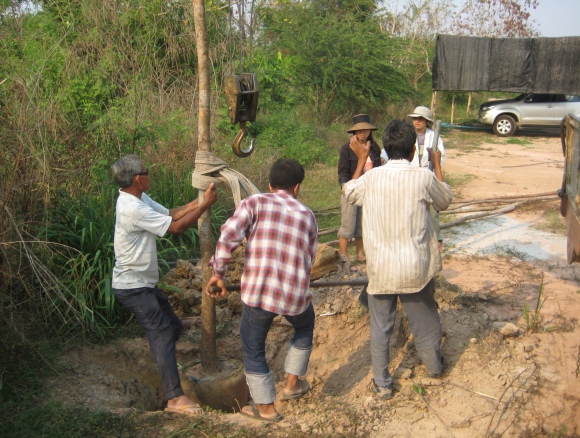 Planting a tree. The burlap bag keeps the root ball together for a short time.
Just yesterday the first load of larger trees came to the foundation property from the forest. We dug holes with a backhoe and planted them with the help of a crane on Uan’s brother’s truck.
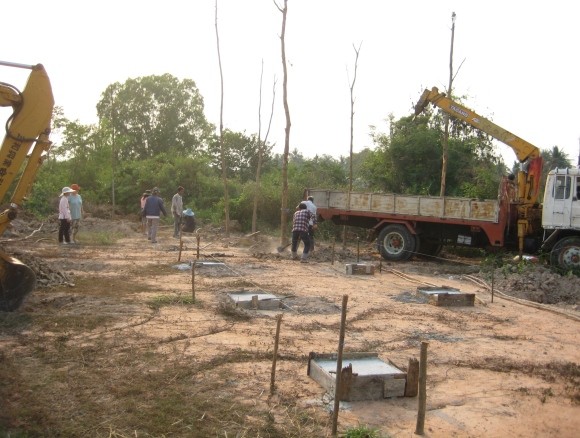 The foreground concrete is for a volunteer shelter. There will be a toilet also. Have I ever mentioned that volunteers are welcome here?
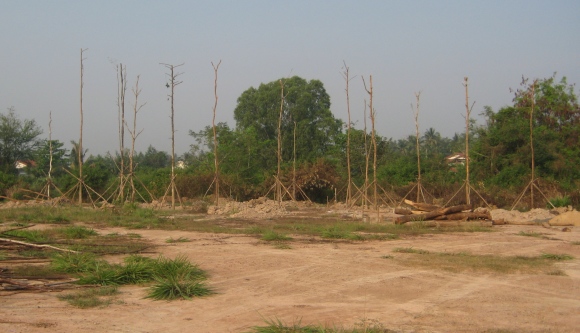 Our two first loads gave us fourteen trees and a few mistakes. I think we know more now.
February 18th, 2010
admin

We are driving 8 meter (26 foot) concrete pilings into the ground to support our new child home. It would be a bit cheaper if we could just dig down a ways and pour some footings, as has often been done in the past in this area. I had been wondering about the necessity of this until I went out and watched them drive some of the pilings. I include a U Tube movie of the driving of one of these pilings. It is pretty typical. I don’t yet know how to edit these things so it is nearly ten minutes long, the time it takes to drive this piling.

Basically, they drive the piling until it goes all the way in, or until it won’t go any further. Either way works fine. We are building one house now, but driving pilings for the two next door houses as well. This avoids having to later drive pilings right next to a completed house, which could cause it to crack.
*** Click here to view pile driving video ***
What you see in this movie is how easily the piling goes in for the first few meters. It really sinks in fast until it hits deeper more dense soil. Apparently that is due to the nature of the soil in the old rice fields, and also that we have placed 1.3 meters of fill on top of that. That is why, where we have built the road, we first dug out a half meter of dirt before filling that half meter plus the other 1.3 with a different kind of dirt we haul in. Every 20 cm layer of road fill was compacted, so the road areas are different.

In the above picture you see Ho, one of our fathers, walking toward the pilings for the first three houses.
By the way, the area around here is very flat, no hills. If you want dirt for fill, you must dig a hole, which becomes a lake. Fortunately, the government wants a reservoir ten kilometers north of here. We are digging it out for them, and get the dirt for free. It’s a good deal for both of us.
The last few weeks we had a family of four from the U.S. but who works in India visiting Nang Rong. They liked being here and had a lot to say about things, some highlights of which were: it is more comfortable here than they thought it would be, and the food is better than they anticipated as well. I have been wanting to check just how easy it is to take a quick trip to Siem Reap and see the huge temple complex of which Angkor Wat, Ta Prohm and Bayon are the most famous parts. They were up for it, and so were a few Thai friends, so off we went.
I was there seven years ago and think temple area is one of the three most impressive sights in the world, the other two being St Peters Basilica in Rome and the Taj Mahal in India. I place the pyramids, the Louvre, Chartres, etc. in the second tier.
There are plenty of places on the internet to learn more about these places, so I will just give you a summary of how we got there from Nang Rong and how much it cost us. We left Tuesday morning and were back by 3 PM Thursday. The full day of Wednesday was enough to see all the major sights in the Archeological park. A second day would allow for more things to be seen, but we covered the highlights and well known areas.
P. California arranged for their van to take eight of us to the border at Poi Pet and later to pick us up at the border and take us back to Nang Rong. They also arranged for a second van to take us from the border into Siem Reap and back. This van was also at our disposal while we stayed there. All this transportation came to $394, or about $50 per person. We could have easily fit nine people, maybe ten, for this same total price.
We did not reserve hotels. There are a number of very nice new and no doubt expensive hotels in Siem Reap if you want that sort of thing. We just had our van drive into the “Old Town” area of Siem Reap and stopped at a likely looking small hotel, the Mandalay. Air conditioned rooms were about $14, but they had only one. We walked across the street and that hotel had three rooms with air but they were up a few flights of stairs. So we went next door to the Millennium and found three rooms on the ground floor. At all three hotels these rooms had air, small TV, their own bathroom and were judged clean and usable by those more particular in our party. They were all about $14 per night.
– Click here to view Siem Reap – Angkor Temple Site –
Here is the cost breakdown we paid per person. We had one full day to see the site, and two evenings to shop and enjoy the Old Town area. We had use of the van and could have seen anything else on those evenings had we chose to do so.
All transportation: $50
Hotels: $14 (per person, two nights, two per room)
Visa: $38 (a visa service speeded things)
Admission to site: $20 (for one day)
Meals: $3 per meal, some at hotel, some in Old Town or site
TOTAL: $140 per person (figure 6 meals)
With what we learned, here is a less expensive way that may be a little more inconvenient:
Transportation: $6.70 bus Nang Rong-Poi Pet, both ways
Cambodia Van: $25. ($200 total for 8 people)
Visa: $25 (get it yourself at the border)
Admission to site, meals, hotels are the same as above
TOTAL: $108 per person
Next time we will spend a few more days. Siem Reap as at the north end of Tonle Sap, the largest lake in Southeast Asia. We want to catch the boat through the lake and down the river to Phnom Pen. We’ll spend a day or so there, and then on down the river, through Viet Nam and to the coastal area.
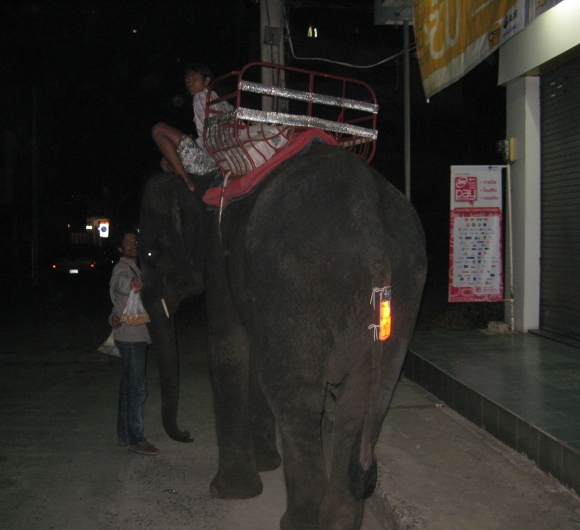
The first picture was taken at night just as I left my landlord’s house. This elephant goes around Nang Rong in the evening with a reflector tied to his tail, stopping at the restaurants. Since the restaurants are open to the outside, the elephant just comes up close, but not close enough to grab anything off your table or tap you on the shoulder with his trunk. If it is dark outside you don’t notice him until he’s there. His handler sells a bag of sugar cane you can buy and feed back to him. My wife always goes for it.
The seat on the elephant suggests you could get a ride if you wanted. We’ve never checked into that. I’ve driven an elephant in the jungle, but driving one in the city is probably beyond my capabilities.
We have a volunteer family visiting for three weeks. The night after their first day it rained. Then there was a light drizzle all day for their second and third days. It is finally leaving and should be back to normal sunny “dry season” days soon.
Now I’m thinking you may not believe me after all I have said about continuous great weather here during “dry” or “cool” season. This is the first time in my three years here that I remember it being like this. If it does rain, which is rare, during this season, it usually rains hard for about ten minutes and that’s it, just like in rainy season.
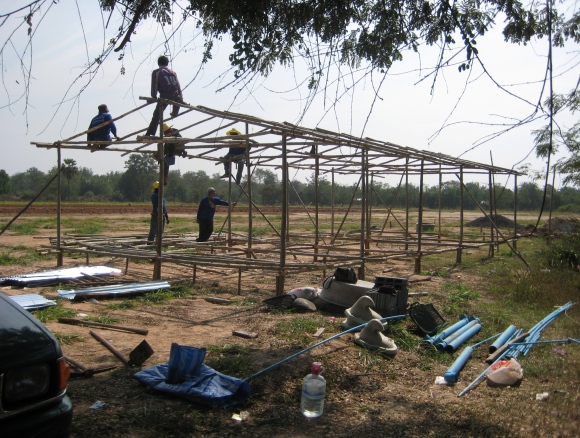
We are just getting started on our first child home in Opportunity Village. In April the first of our two families, now in rental homes, will move into the new house. We are looking to add one or if possible two more families in rental homes this year. The second picture is not going to be the new home. It’s the temporary shelter, and perhaps home, for the workers building the house. It’s over by the main canal on the west side of the property.
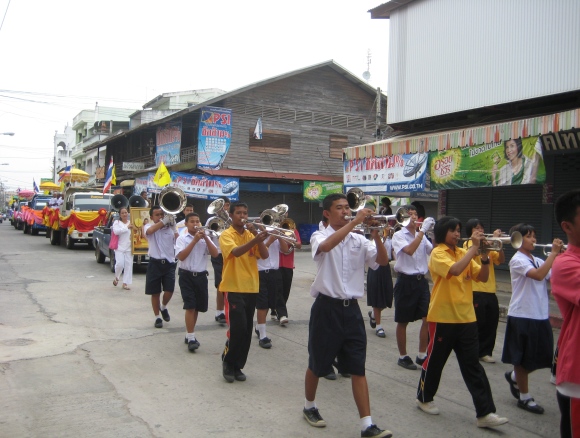
The final thing to report is that I ran into another parade two days ago, on the street that crosses my street five houses down. The flatbed trucks you see coming held monks and nuns sitting in rows. Something to do with buddhism, of course, but other than that I don’t know. Now just about every street around me has had a parade in the last year except mine. Some weddings, a few ordinations (kids becoming a monk for awhile) and buddhist house warming celebrations, but no real parades.
This is off my subject, but since I have already written about Haiti…
While looking at some news today I was reminded about something else. There is a lot of talk about relief donations for the Haitian disaster. I see UNICEF and the American Red Cross mentioned a lot. Also mentioned are the numerous fake charities and other donation scams that always pop up at times like these.
I’d like to remind you about the Salvation Army. Before the Katrina disaster I knew that in most cases of disaster relief, for every two dollars donated to the American Red Cross, one dollar to the Salvation Army provided the same amount of food, clothing, shelter or whatever else was being provided for relief. After Katrina I read further reports that the same factor still held during and after that disaster. I don’t know the figures for UNICEF, but from my experience with the U.N and their personnel, I would guess that they would be as high as the Red Cross. The Red Cross, UNICEF and other like well known organizations are honest and ethical. I just question their efficiency, salary rates of some of their employees, and such things.
The Salvation Army has long had a presence in Haiti. May I suggest if you are going to donate, think about giving a bit in that direction. Do make sure you know where you are donating to avoid your money being wasted. Some people think it is easier to give away money than it is to make it in the first place. I’m not so sure about that.
There is one other issue I can’t help bringing up again about the Haiti earthquake. It is hard to find specifics, but many are commenting that it is the effect of the earthquake on (concrete/masonry) buildings that kill people, not the earthquake itself. If you are out in the open when it strikes you are unlikely to be hurt.
Please refer to my earlier post if you have not read it. The main thing that causes buildings to fall down is lack of shear walls. Some information suggests that the major movement of the Haiti quake may have been up and down rather than side to side. Shear wall’s main advantage is protection from side forces. Also, an 7.0 quake anywhere is a pretty big one. Then there were other problems such as too little cement (the expensive component) in the concrete and too little steel reinforcement.
OK, make that steel reinforced shear walls made with real concrete. Still, my feeling is that loss of life would have been cut in half, in the Haiti quake if shear walls had been present. If in the near future some engineer states that life loss would have been ten percent or less I would not be surprised. I hope to see some analyses coming out of the disaster in the future that will show this more accurately.
Imagine a Haiti where the buildings in the port, airport, police stations, hotels, government buildings were damaged but not collapsed. We’d have a hundred thousand or so more people to worry about feeding, but we could all live with that. The time is coming very soon when the worry and effort will be on rebuilding. Any aid to that effect must have structural requirement strings attached. We need a force of UN building inspectors to come in after these disasters. Whatever it costs will be saved in the long run.
Some places like Haiti are earthquake prone. Others like Nang Rong are not. Still, since it is so inexpensive to do so, shear walls should be used in all concrete construction.
This may sound like an advertisement, but if you have anything to do with a building project anywhere in the world remember the name “shear wall”. Ask for them by name. Accept no substitute.
The crisis in Haiti has everyone’s attention, including mine. I will not comment about it because I know next to nothing about that area. Some have been drawing parallels between it and the Myanmar crisis of two years ago. In Haiti aid is bottled up because the infrastructure is largely destroyed. In Myanmar there was not much infrastructure to be destroyed in the delta area, but the thing that caught everyone’s attention was that aid was not getting through simply because the generals controlling the military government would not let it through.
I do not wish to appear as an apologist for the military government of Myanmar, but there were things that the U.S. and European countries did that may have encouraged the general’s response. The best summary of this is in the second and third paragraphs of the first page of a letter from Derek Tonkin, whose site networkmyanmar.org tracks what happens in Myanmar. I can’t say it better, so I won’t.
There are many small tour operators on Lanta island offering snorkeling, diving, elephant rain forest expeditions and kayaking. Sue and I went on three. The first was to Ko Rok, which is considered the best nearby snorkeling. We saw a few fish longer than a foot, but many smaller ones of many different colors and patters. Some were bright iridescent colors. Sue is not the most enthusiastic snorkeler; I usually have to drag her along to snorkeling. We had about three forty minute sessions. In the first she was getting used to the borrowed equipment, which I thought was good. The second she enjoyed. By the third she wanted to stay out four more hours.
Ko Rok is actually two islands very close together. We snorkeled off the rocky areas. There are beautiful beaches where the islands face each other. The sand is very white and very fine. After the first two sessions we went to one of the beaches to relax and have lunch. It was a great setting.
Our second trip was a half hour elephant ride up to a rain forest. From there we hiked up to a cave and waterfall. The cave was nice but not spectacular at all. The waterfall was large, covering a lot of area but just dripping at this time of year.
When it was time to ride the elephant back down we were ready to get on a different elephant when the handler of our previous one showed up and asked us to wait for him. We had ridden up on one of the few males. He had been rather difficult, stopping to eat, stepping down into a stream to have a drink, etc. His handler had to work with him a bit to get him back on the trail. I wanted to see if I could drive going back, and thought a female would be easier to direct.
I was still able to drive. The handler took my camera and walked along behind us. Sitting on the neck works better in some ways than the chair on the back, which pitches around a bit more when the elephant walks. Going downhill is the most difficult because you feel like you’ll get pitched over his head. Also, the skin on his neck was loose, and slide from side to side easily. He helped by pulling his ears back to clamp my legs. He did stop in a stream to drink once, but turned on a dime and otherwise was pretty easy. I think it is similar going back to the stable on a rented horse.
The third outing was the “Four Island Tour” which included the emerald cave. The islands around Lanta are really beautiful. Many of them are mound shaped, heavily forested and higher than they are wide. The cave is actually a long passageway through the base of the island to an interior sandy beach enclosed on all sides by high cliffs. The cliffs are alive with all kinds of tropical foliage and open only to the sky. We floated through the cave in life jackets. It was completely dark in areas. If you bring children on this you should bring a waterproof flashlight to help calm them.
We have taken the day trips associated with various vacations and cruises around the world. I would rate these three trips equal to or better than any of them.
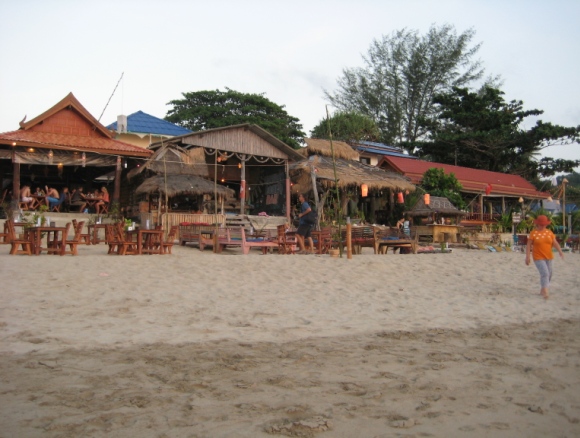
We are back from our vacation on Lanta island (“ko” means “island”). It was the greatest place for a beach vacation. It may not be what you want if you are looking for other things. It is not the place for upscale hotels or upscale anything. I remember only a few hotel buildings that reached two stories. None of these were on the beach side of the road. For walking the beach, swimming off the beach, relaxing on a lounge under an umbrella and just being a “beach bum” Lanta island is the best place Sue or I have yet been.
Most of the restaurants and bars are right on the beach and can be little more than large shacks built of logs, wood and bamboo. Their tables are out on the sand in front of them. It is rustic in the extreme. Lodgings are mostly single detached cabins. These can be newer or older. Most have air, TV and a small refrigerator. Some face the beach and some, at lower prices are the next row back. Prices on the beach varied from $150 (pretty spiffy) to $30 per night.
- Click here to see Lanta Island pictures –
We were originally booked into Moonlight Bay resort (more about this later), but after one night moved to Nature Beach resort which is on Klong Nin Beach. We paid about $35 per night for a room that was satisfactory to Sue. She is more particular than I am, so if she liked it, chances are most people would. Our room was not on the beach, but few places were full. Had we wanted a beachfront cottage, they were available. We found that the few steps to the beach was a good trade off for the kind of room Sue liked with the price we paid.
We did not know when we checked in, but Nature Beach was maybe the hub of activity among the many resorts on Klong Nin Beach. The place was certainly not packed, but probably more ate at Nature Beach than other places. We tried many along the beach, but tended to end up back at Nature Beach.
I do absolutely recommend the Klong Nin Beach area for families with young children. Wave action is minimal and the beach appears very safe. The kids there often ran free, with others and the restaurant staff looking after them and giving them a hand when needed.





